
Rachel Latta is the new OUSD School Board Director for District 1. Families in Action sat down with Director Latta to hear her perspective on some timely issues relating to Oakland public education. Below is a transcript of the conversation, edited for clarity. Questions from FIA are in bold.
In this interview District 1 School Board member, Rachel Latta, discussed various strategies for addressing the education crisis in Oakland. She is focusing on improving student academic outcomes, fostering parental involvement, and enhancing school safety. She emphasized the importance of maintaining student achievement as a top priority, using transparent metrics and tools like i-Ready to track progress. Latta also addressed the need for clear criteria in approving charter schools, prioritizing academic success and financial stability. Regarding parental engagement, she highlighted the significance of clear communication, language access, and flexible participation options. On school safety, she advocated for stronger relationships with students through “Culture Keepers” to prevent violence, while also stressing the importance of supporting immigrant families amid deportation fears. Latta underscored the necessity of protecting student rights and ensuring the safety of undocumented families, with measures like professional development for staff and a community hotline to report ICE activities.
Check out the full interview (with time stamps) and transcript below:
Question: Oakland is suffering through an education crisis. Just 2 in 10 Black and Brown students can read at grade level, and only 1 in 10 are a grade level in math, and there has been lackluster progress to improve those results. How do you think our city should address the crisis and turn these results around?
Rachel Latta: You mentioned the city, and I do think ensuring it’s not just the school district leaders, obviously, as a school board member, I’m really thinking about it. What are the ways that we can focus and prioritize academic outcomes for our students?
I have moved from being a parent activist or organizer to being on the school board. I’m also in conversations with city council members or other government leaders, thinking about how we can continue the supports that we’ve started around focusing on academic outcomes for students. I think that it’s very, very important that as we, as a school board and as a city, work through – whether it’s our budget issues, whether it’s other important priorities that come up – that we always stay focused on student achievement and student outcomes.
I’ll just say the first thing is just making sure that myself as a school board director and all of us new school leaders really stay focused on that being the primary driver of everything that we do. Whenever we’re thinking about initiatives, whether we’re talking about increasing programs, or in the current case, maybe scaling back on programs, what are those impacts on student achievement?
The other thing that I’ll just mention that’s really important to me is that we’re also having really clear and also transparent easily explainable metrics. What are the benchmarks we’re looking for throughout the year?
I think that we’re moving in the right direction as a district. Right now, we’re using i-ready as one of the ways that we ensure that students are making progress month to month, instead of just waiting for the large aspect test at the end of the year. I do think we need to do more of that, and present it to the public more. The biggest thing, I would say, is keeping it a priority and making sure that we keep funding it as a priority, as well.
Question: What criteria will you use for approving or denying charter schools?
Rachel Latta: That’s a great question. We just had nine renewals at the school board, and I wasn’t on the school board then. Now that we’re preparing for six more renewals this fall, or could be as early as starting this summer, some of those applications coming through, the metrics we’re using are essentially the same as what were used in the fall.
I think to kind of keep to the principle of what we’re doing is that, charter schools are kind of autonomous schools that are open to the public that, instead of district schools, have this idea that there’s innovation that’s happening. As part of the school portfolio that we have in Oakland, we have as authorizers of public schools, we have to use a very strict set of criteria.
I think for the vast majority of schools, that’s having good academic progress and having an academic program. And are sound fiscally. Those are the biggest drivers for why we would approve a charter school.
We look at governance, the bylaws, we look at the budget, and we look at academics, and really compare apples to apples with other charter schools and district schools. For the charter schools that are being run well and offering a good academic program, and have a reasonable expectation of continuing to deliver that service, then they would get approved.
For denial, broadly, I think that really comes down to an academic program that’s not performing, pretty significant financial or governance concerns. We have an Office of Charter Schools that runs that process.
As the board, we give a general direction about information that we’re interested in, and certainly as representatives of the public, we ask questions through that process. But we really rely on the charter school office to make a recommendation to the board about whether they think the academic program, and the school, deserves a renewal. We really rely on the expertise of the Charter Schools Office.
For myself as the new chair of the Charter Matters Committee, I’m starting to set up site visits at charter schools, not only for charter schools that are coming up for renewal, but also to anticipate questions that might come up from my colleagues, or to be really available to charter schools as they’re preparing for a pretty stressful renewal process. So that’s, generally speaking, the criteria, and that’s all on the charter school website, if people are interested.
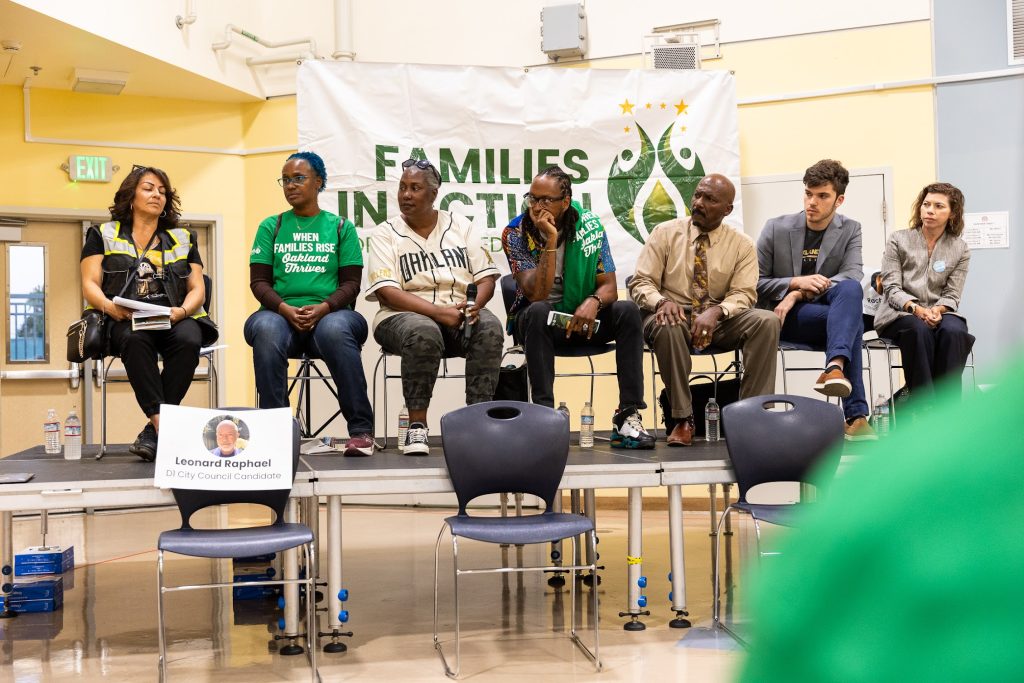
(Rachel along her running mates at FIA’s Candidate Forum 2024)
Question: Students perform better when their parents are involved in their education. There are structural barriers that prevent many parents from engaging in Oakland public schools, including lack of time and resources and language. What ideas do you have to improve parental involvement in Oakland public schools?
Rachel Latta: Yes, I think that’s a great idea. I am a parent of two kids in OUSD, soon to be three in the fall. I certainly see firsthand how important it is for parents to be engaged, and that’s one of the reasons why I ran for the school board.
In terms of structural barriers, I wish that we could find a way as a district to give us parents more time in the day. I do think that’s probably one of the biggest things a lot of us would say. I certainly struggle with working and having multiple kids to try to keep on top of everything that’s happening.
I do think that there’s some pretty basic things that we should continue to do, even in this age of scaling back. One is communicating with parents about how they can track their own students’ progress. For younger learners, that’s giving people access to their kids’ i-Ready data. Basically whenever they want it. It is still too difficult to find, but I do think that has been really helpful and gives people access in multiple languages as well.
I think, #2, is communicating what are some upcoming ways that parents can get involved early? Some of that is supporting principals with resources to deliver that information, and also supporting schools with translation and hybrid options so that parents who are working, parents who speak another language, could still stay involved.
I think the other piece is around supporting the literacy nights, and teaching parents how to read their i-Ready report. The other thing that I would add, that I’ve been asking about, is around also having a few more drop-in opportunities we have throughout the year at times where people can get on a zoom. Basically office hours that are available to help people navigate: What does your i-Ready report mean?
We have an upcoming night where people can give feedback on Social Studies curriculum. I think having those a little bit more frequently, so that parents can engage. Then in the upper grades, some middle schools, the middle school network is moving towards this. They’re also sharing i-Ready data with their parents, and also having students and parents lead their conferences.
Instead of receiving information as a one-way street, which is more traditional, a lot of schools in Oakland are moving towards a model where we put the student or the parent at the center to figure out and deliver that information so that we’re being more responsive. Those efforts are broadly important.
The other piece of it is implementing some more clear check-ins at the beginning of the year, so that parents can be ready for that. Having more time for people to be able to get off of work and prepare child care for other students is a priority of mine as well.
Question: Over the past decade, high school graduation rates have improved, in part because of Measure N and the creation of Linked Learning academies. However, just 50 percent of OUSD graduates complete their A-G requirements, meaning half the graduates are ineligible to apply to UC and CSU schools. How can we improve those rates so all students graduate ready for the next step and eligible for college?
Rachel Latta: There are a couple of big pieces to that. One is that a lot of that work is living in the Measure N and now Measure H committee and in Teaching and Learning. There’s been a lot of work around ensuring that we’re making it very clear to students and their families about what their progress is as they go along.
The other piece that’s an important component is that we ensure that we’re intervening earlier for students who are off track. We’re very fortunate in Oakland to have so many opportunities, with community colleges nearby, to having multiple comprehensive and alternative education high schools. I do think that we have to balance the desire to keep students at a comprehensive high school with really not letting students get too far behind.
There’s a little bit of a collaboration that we need to focus on between Measure N and H and some of the alternative high schools so that we’re having fewer students graduate with the 190 credits. That’s part of where some of that A-G comes from – we have a population of students who get a little bit behind and then graduate with 190 credits. They graduate, but they’re not A-G eligible.
That also means that we need to ensure that we’re continuing to fund the counselors that help navigate this process with students. Because I do think it becomes very difficult if you get to your junior year and you’re off track significantly for A-G. One of the things that we’re looking at with the budget adjustments is making sure that we’re protecting those resources for students and families so that we can, in freshmen and sophomore year, help case manage as (students) get behind.
Measure N and H has done some really deep work around increasing that graduation rate and making sure that students, no matter where they go to high school, have access to college prep classes, and moving that A-G number faster. We’ll be getting some reports about what we can do in the Teaching and Learning Committee that will get shared out as well.
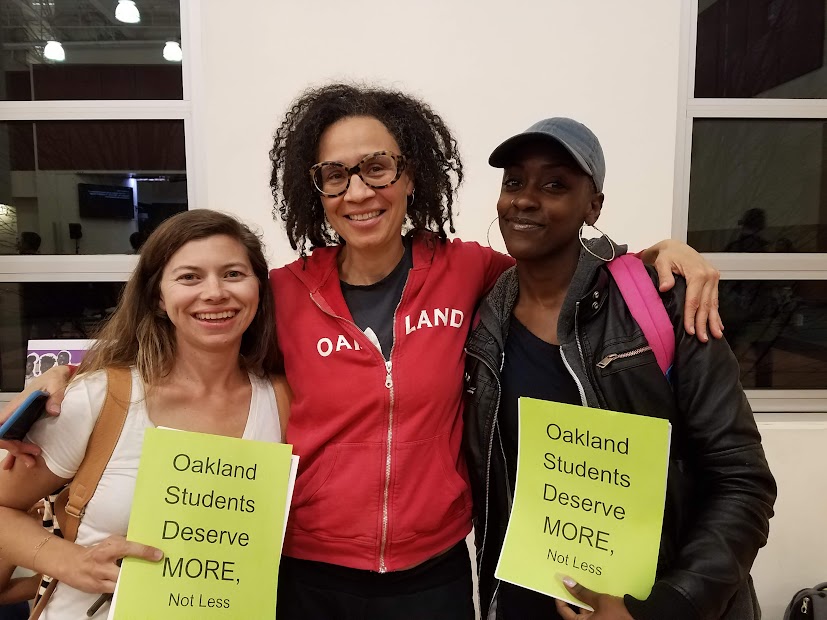
Rachel (on the left) advocating for Oakland Students
Question: School safety is a top concern for families. Last school year, there was a school shooting on an O USD campus. How can school safety in Oakland be improved?
Rachel Latta: That’s another community-wide concern around how we keep our community spaces safe. I think we are taking very seriously how we can balance safety, keeping students and staff safe and families safe, while also balancing student concerns around bringing police back to school.
Students have made it really clear that they want safety, but they don’t want to go back to having school police. We, as a district, have really focused on how we have really robust safety Culture Keepers on campus that can identify issues early. I think in the places that we have Culture Keepers who’ve been a part of the community for a long time, what I’ve heard from them is that they do feel like having consistency on a campus (is important).
One thing we have to balance with budget cuts is ensuring that we’re maintaining the Culture Keepers that have been effective at schools, and not just avoiding something as horrible as a shooting, but preventing them before they start. Addressing issues early really means relationships with students and families.
As we think about being good stewards of money and trying to balance our budget, we also need to be really, really aware that when we spread Culture Keepers across multiple campuses, that their relationships become just less deep. They’re not able to be as engaged with individual students and families.
My #1 priority is that when we think about school safety, that we’re really thinking about the relationships that have prevented violent incidents in the past, and how we continue to fund those initiatives. There’s been some increase in having student identification, having some clearer standards for when there are athletic events or dances, clearly communicating to students and families about minimizing how many people can come and balancing having community celebrations and safety. Those are probably the two biggest things.
The other piece is just around some of the coordination between our team of staff that work on not just behavioral incidents and but also suspensions and the link with achievement because we do see a connection between students who are receiving special education services, students who are Black and Brown, students who are identified as speaking another language than English, that they’re over represented in our suspensions and in our incidents on campus. Continuing to monitor what has happened up until the point at which a student is suspended, the point at which a student is potentially even considered for expulsion, that connects to the ways in which we haven’t been there for those young people.
I think about the academic services that need to be provided to all children, so that they also feel not just socially accepted and part of a community, but also feel like schools are places where they’re academically excelling and receiving a rigorous education are two other pieces that are connected to safety.
Question: Many Oakland families live in fear of deportation, with the Trump administration vowing to deport millions of undocumented immigrants, and they’re worried about sending their children to school. What can schools do to protect students and families?
Rachel Latta: This is really, really challenging. I’m a nurse midwife at a community clinic serving predominantly immigrant families. We also had to start having plans for, if we have an immigration raid, and how we protect our patients. We are having those same conversations at the district level.
The first thing that we can do is have relationships with families to explain what our procedures are. How do we keep students safe, and what are the things that we’re doing? The district has spent a lot of time over the last two weeks doing professional development and meetings with school staff, with Community School managers and around ‘How do we actually understand when there’s an ICE raid in progress? What do we need to look for? How do we ensure that we’re not giving access to our schools to law enforcement in a way that complies with the law? We also don’t want to create a situation that’s unsafe.
We need to ensure that our school staff, that we’re all becoming experts in what is a legally acceptable immigration warrant and what is something that we can refuse? How do we have district staff that are available to school staff? There is a hotline that has been given out to parents so that if they see ICE activity in Oakland, they can report it. That’s the other piece, making sure that if we in the community see any kind of ICE agents around or cars that we’re aware, we can let people know.
The other piece is being really transparent with families when, even if we know it’s a rumor that an immigration official has shown up at a school, that we’re communicating quickly what has happened. With Parent Square, that’s one way because it does immediate translation for any notices. We’ve talked to families and Community School managers and principals around updating their emergency contact information. That’s really about protecting students.
In the first Trump administration, we did have students whose parents were picked up by ICE, even if they were then in detention for a day or two, we wanted to make sure that there was always somebody who could pick students up.
The last thing is around lending our district’s voice and around fighting the Trump administration on the deportations, on supporting the work that’s happening with the Attorney General’s Office, around having legal challenges to any of the ICE activities. I think having a really strong voice in the community that ‘we don’t support that,’ that we want to make sure that all of our families feel welcome, and we’re fighting for them and for their students as well.