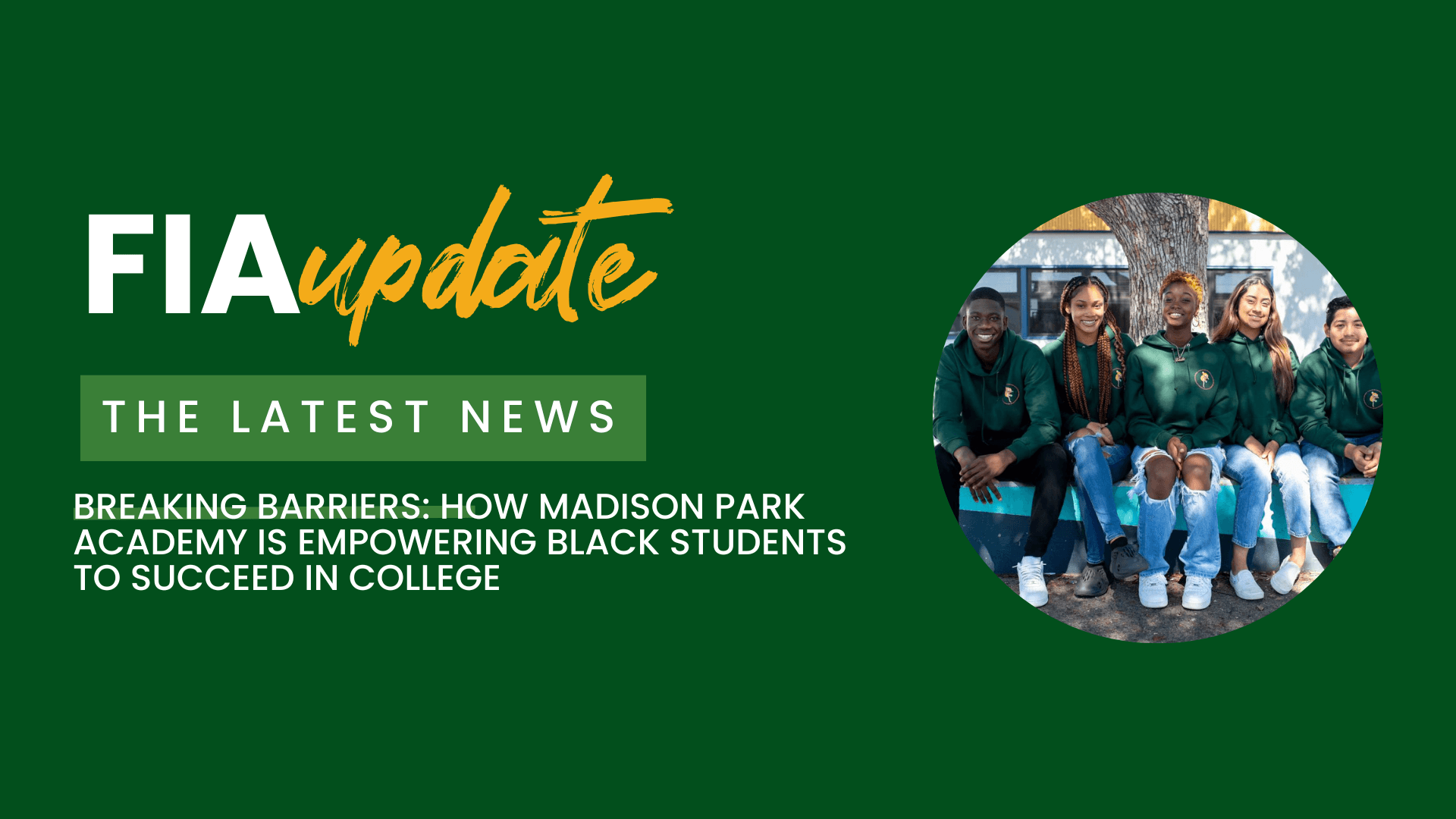
As part of its Raise the Bar campaign, FIA is committed to understanding and publicizing the strategies behind the success at schools where Black and Brown students are making significant academic strides. Madison Park is one of the 2023 Oakland schools that is raising the bar for A-G completion among Black students.

Habeeb Tiamiyu, an African American young man who grew up in Oakland, knew he always wanted to go to UC Berkeley. Sure, there were other schools he applied to, like UCLA and some HBCUs. But Berkeley was really the one.
His family knew it – his two older siblings went there and set the standard. His friends knew it – many of the students in his class at Madison Park Academy (MPA) were just as focused on academics and they regularly talked about college.
His teachers and the administrators at MPA – a school with grades 6-12 located in the Sobrante Park area of East Oakland where just about all the 600 or so students classify as socioeconomically disadvantaged and most are African American and Latino – definitely knew it. They’d heard him talk about that goal since middle school.
They were with him each step of the way, providing a safe, familiar and rigorous learning environment and a college-going culture where students and parents are encouraged to share their academic hopes and dreams, and then attain them.
Though he worked hard and was one of the top students in his class, Habeeb was anxious to open the letter he received from UC Berkeley that spring. He didn’t want to do it alone, so he called on someone he trusted to open it with him: MPA Assistant Principal Bianca Lorenz.
“I remember that day well, it’s a core memory of mine,” Habeeb said. “I was super nervous. I got home and hopped on a zoom with Lorenz so we could open the letter together. I remember opening the letter and reading, ‘Congratulations.’ We didn’t even finish reading the whole letter after that. We just celebrated.”

Raising the Bar for Black students
Madison Park Academy is a school that is Raising the Bar – a school identified by FIA in our 2023 data report as beating the odds for Black and Latinx students in math, ELA and college eligibility.
Between 2022 and 2023, the A-G eligibility rate at Madison Park jumped 46 percent. Across the Oakland Unified School District, 55 percent of African American students completed their A-G requirements and were eligible to attend a UC or CSU school, compared to 67 percent of African American students at MPA.
There are a number of factors that have contributed to the rise in A-G completion, MPA Assistant Principal Bianca Lorenz said, including a motivated group of students who had been at the school for years, families who were supportive and shared the same goals, and consistent adults like Lorenz (who started at MPA as a math teacher 10 years ago) and have built up trust from years of being there for students.

Intentional A-G structures at MPA
Along with the strong school culture is a sound structure and focus on A-G requirements that
ensures students are college-eligible. For example, students who receive a “D” are strongly encouraged to retake the course, since that grade does not count toward A-G eligibility.
Students meet with a counselor all four years and start on an A-G plan when they are freshman. Brianna Wilkinson, MPA’s Pathway Coach, said that it’s important to have a lot of A-G touch points throughout a student’s four years of high school.
So the conversation starts with freshmen about passing their classes and internships they may be interested in. Sophomores learn about the college options like UCs and CSUs and start thinking about what they want to major in. Junior year students go into more detail about the college and career they want to pursue and drill down on those specific requirements.
“We have one-on-ones regularly so students can have that conversation throughout their four years,” Brianna said.
The intentional choices administrators make to ensure students are A-G extends to how the master schedule is designed. The block scheduling allows for students who are passing to take extra classes they are interested in during their junior and senior years while students who have struggled have room in their schedule to retake classes and recoup credits.

MPA offers five dual enrollment courses so students can gain college credit before they graduate high school. One of the dual enrollment courses offered is a college language class. One semester of a college language class fulfills the A-G language requirement. While many of MPA’s Latino students speak Spanish and are able to test out of the language requirement, many African American students did not have that same option. Taking a semester of French from a college professor has been an equitable solution.
“That has allowed our Black students to get the language requirement done in a semester and then enroll in other college classes,” Lorenz said. She shared that one African American student currently at MPA has taken 14 college courses so far and plans to graduate early. Habeeb shared taking college courses at MPA helped spike his GPA.
“It’s creating a system where there are safeguards in place,” Lorenz said. “Our whole Future Center team is supporting our kids through college classes so they can be successful. So when they get to college, it’s not going to be a complete shock. It’s still going to be hard, but at least they have some idea of what’s happening.”
Black students supported to succeed
London Edwards is an MPA graduate in the same class as Habeeb. She’s now a college student at North Carolina A&T, studying pre-nursing. London started attending MPA in 6th grade and says she stays in touch with friends from those days.
While she was the only one in their friend group to go to school across the country, she said her experience as an MPA student made it easier. She developed a close relationship with school leaders while at MPA, support she still feels.
“Because I was close to admin and had that support, I felt like I could go anywhere and still have that support,” London said. “I have that support system so I knew anywhere I decided to go I would be fine because I still have them to talk to and reach out for advice.”
When she was a student at MPA, London said she was “constantly reminded” by administrators and teachers about college requirements and college eligibility. “It was never like, ‘Oh, I just need to pass this class,” she said. “I always wanted to succeed during my A-G requirements and it was also clear what we needed to get done.”
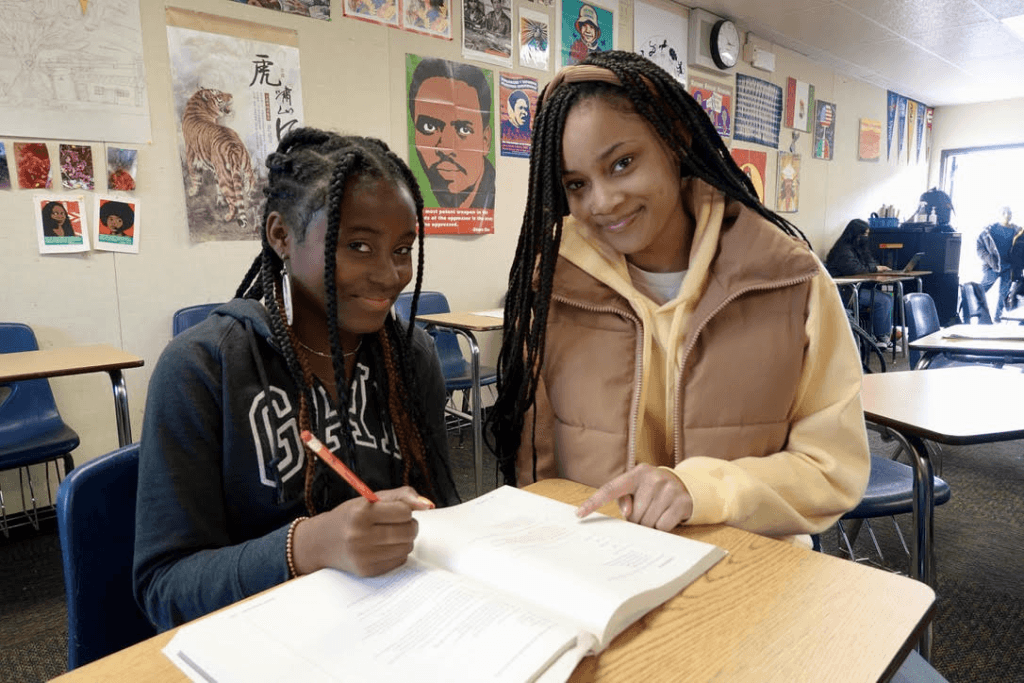
London highlighted MPA’s mentorship program as playing a key role in the school’s culture. Students in high school mentor middle school students, building relationships with them and helping them with their homework. London said she’s still in contact with a student she mentored, who is now graduating this year.
“You ask them, ‘What’s going on? Are you doing OK mentally? Stuff they don’t want to talk to the admin about. They can talk to us because we’re closer in age and they might be more comfortable talking (to another student),” London said.
Habeeb is now a computer science major at Cal, with extremely challenging classes on his schedule like electrical engineering. He’s proud of the work he’s put in and the progress he’s made with a difficult major at a top college. He gives a lot of credit to his time at MPA and the consistency of the teachers and administrators.
“The staff was always there being very supportive,” he said. “They are ready to meet you where you are and tell you what you need to do: this is the next step and this is what you need. They really want to make sure we are on track and everything is done on time. I’m really grateful for everyone who helped.”