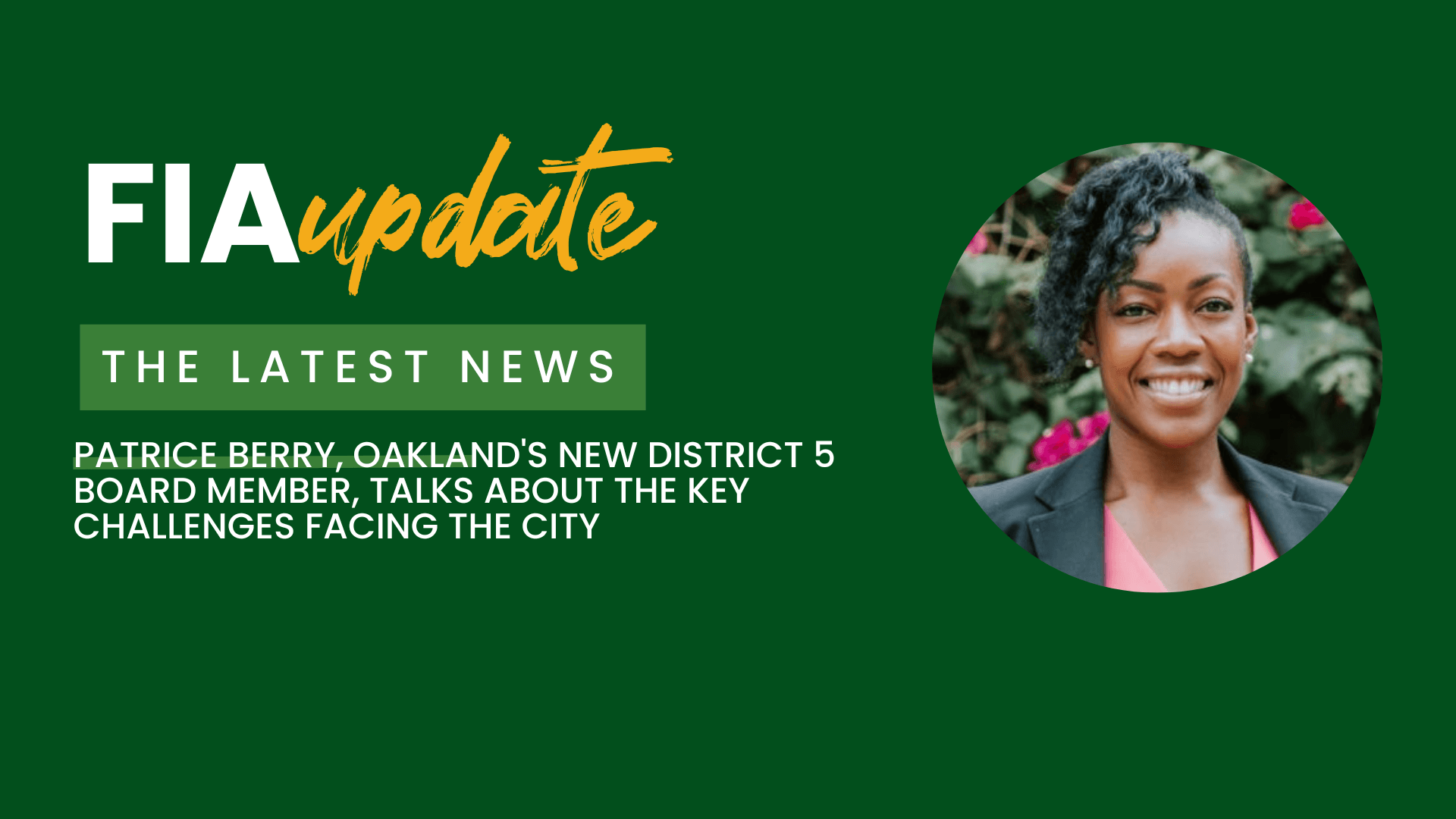
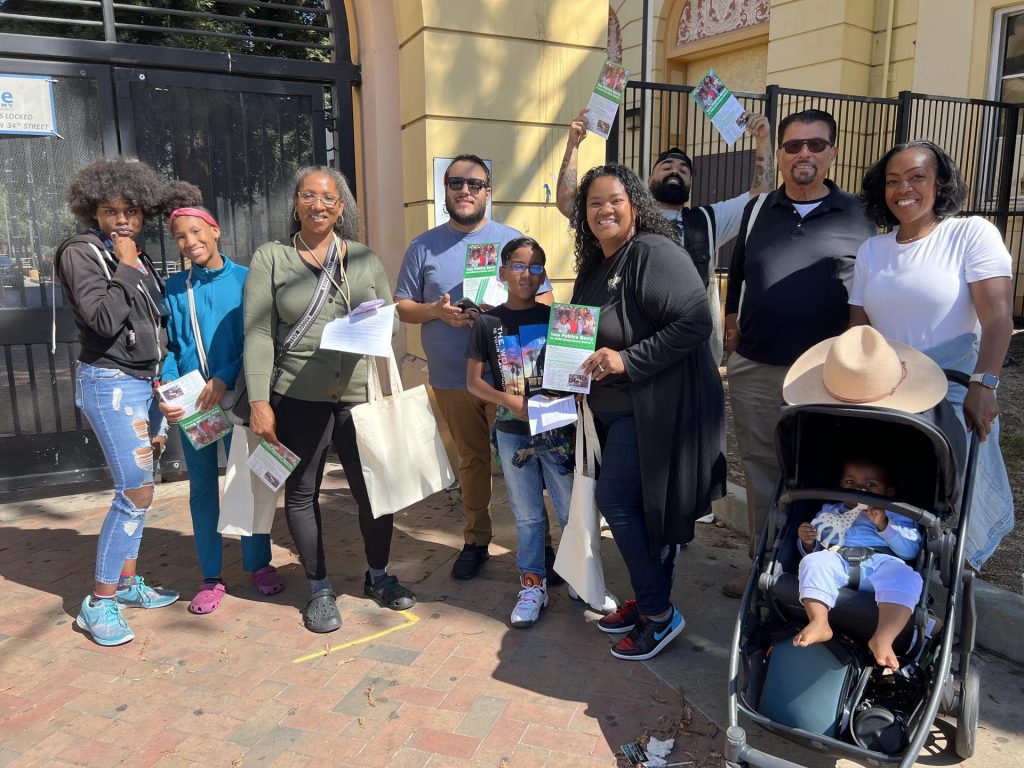
Patrice Berry is the new OUSD School Board Director for District 5. Families in Action sat down with Director Berry to hear her perspective on some timely issues relating to Oakland public education. Below is a transcript of the conversation, edited for clarity. Questions from FIA are in bold.
In this interview, District 5 School Board member Patrice Berry discusses key challenges facing Oakland’s education system, including the urgent need to address the literacy and math gaps among Black and Brown students. She emphasizes equity in charter school decisions, improving parental involvement through community-based resources, and ensuring students are prepared for college and careers. Patrice also advocates for stronger partnerships to enhance school safety and support immigrant families. Her focus remains on creating an equitable, supportive, and community-driven education system.
Check out the full interview (with time stamps) and transcript below:
Question: Oakland is suffering through an education crisis. Just 2 in 10 Black and Brown students can read at grade level, and only 1 in 10 are at grade level in math, and there has been lackluster progress to improve those results. How do you think our city should address the crisis and turn these results around?
Patrice Berry: I think there are a few high level things that I believe need to happen, and there are a few things over which I don’t think I have as much influence or even expertise, but are still worth exploring.
First, I think, with a problem that grave, we need to treat it with the urgency it deserves. And you see what has happened recently with the executive orders, the announcement of freezing federal funds. For example, it’s consuming all of the oxygen in every room that I’ve been in, and we need people focused on these issues with the same amount of energy and attention.
I think with that, we should see it on every teaching and learning committee agenda meeting. It should show up in every school board meeting agenda, every school board member, including me, we should all be engaging deeply with our schools and learning from other school boards across the state with curiosity, learning about the successes and the challenges. I even think that it would come up in our conversations about who our next superintendent will be. It should be a priority for them as well.
And then if I look at things that fall within closer to programming, to what’s happening inside classrooms, I think there are some things that most people agree work really well: differentiated instruction, small groups, individualized attention, additional time for extra literacy and math practice, reiterating concepts at home. I think all of these things are important, but all of these things also cost money.
So again, if they’re not showing up in our school board meetings and being factored into sort of all the conversations happening around the future superintendent and budget balancing, then it’s easy to get lost in sort of like the world of competing priorities.
Question: What criteria will you use for approving or denying charter schools?
Patrice Berry: In some ways, this question is easier, because there are some laws that tightly prescribe how we make decisions about charter schools.
But in terms of the things that I care about, I care about equity. I care that all of our children get quality education and learning experiences, and I feel like all of our schools should be held accountable to providing those kinds of learning experiences for students and making sure that no student gets left out of that. Regardless of whether students have unique or special needs, that they get their services, and regardless of whether students make up a small minority of the population in a school, they get the resources and the programs that they need in that building.
My decision making is really equity-centered. I believe in equity-centered accountability, and I think that focus, that emphasis, plus, the very concrete policies that we have, the direction we get from the state, that’s how I’m going to make my decisions.
I think there are some people who have introduced to me the notion that closing charter schools could be a way that we could increase enrollment at OUSD and cut unnecessary costs. Although that might be true, there are a lot of students and families who rely on our charter schools for learning experiences they really desire, and I don’t think that the decisions we make about opening or closing charter schools should be with an interest in how much revenue we can generate if they didn’t exist. I’m more focused on, is a charter school providing high quality education experiences for children? Are they doing it in a way that centers equity, and are they getting results?
Question: Students perform better when their parents are involved in their education. There are structural barriers, however, that prevent many parents from getting involved, including lack of time, resources and language. What ideas do you have to improve parental involvement in Oakland public schools?
Patrice Berry: I’m a huge advocate for Community School managers, for Family Resource Centers and all the programs and the services, the resources that really uplift families and make it easier for parents and caregivers to not only meet their basic needs, but to also show up as their full selves in our schools. I was just at a Family Resource Center, hosting a meeting for educators and families and I really wanted to get feedback from community that would not have been possible had it not been for the relationship that Community School Managers have with parents in the community and their knowledge and awareness of the needs of community, and without the Family Resource Center that hosted it.
I think these resources are really important, and every parent doesn’t have time in the middle of the day to show up to a meeting like that. And so I think one thing we really need to do is differentiate how we define parent involvement so that it includes the myriad of ways that parents can show up for their kids’ education. It’s not just about coming to a meeting. It’s not just about making themselves available to read to their kid at night.
I think being able to be responsive to what every family has is really important. I think in that way, schools, including their programs and services that they have available like a Family Resource Center, continuing to do the work of making sure that we reduce the barriers, making sure that you can communicate with families, with a community of families where there are eight different languages represented, requires resources translation, not just in real time, but also of printed material, and we have to invest in that. I mentioned this earlier when I was sharing my response to how we really address some of the huge literacy and math gaps that we have. We have to invest in the programs and services that we know can make it possible for us to deliver the kind of care and parent involvement that is included in that package.
Question: Over the past decade, high school graduation rates have improved, in part because of Measure N and the creation of Linked Learning academies. However, just 50 percent of OSD graduates complete their A-G requirements, meaning that half the graduates are ineligible to apply to UC and CSU schools. How can we improve those rates so all students graduate ready for the next step and eligible for college?
Patrice Berry: There is a lot of good work happening as a result of the Measure N and the Measure H funding, the Linked Learning programming happening at sites across the city. One thing that I’m very interested in, after having just attended a presentation that was done on the work coming out of that measure is wanting to convene people to say, ‘OK, here’s what we know really worked.’ As the school district is making decisions about what resources, programs and staff to cut, we just want you to know that these are the reasons why we’ve seen growth in gains, not just overall, but for specific demographic groups as well.
I want to say that some things I think work really well. Every child has an opportunity, I believe, to pursue their dreams, but if we don’t even know what students care about and what they’re dreaming for, I’m not sure how we can tap into that as we’re helping them move through the system of education.
I would love to see how schools are engaging students in imagination, in dreaming, in goal, setting for their future. Those conversations can start very early. I love that Oakland Promise’s Brilliant Baby program introduces that. I love the K to C program. I love that they even have a model for engaging students very early on and thinking about their journeys.
I think too often students get to high school and it’s the first time they’re being asked to think about it. They really haven’t built up even the internal sort of emotional and intellectual muscle to connect to their academic experiences in a way that’s meaningful to them. Starting earlier, I think is really important.
I even think that there’s an opportunity for us to guarantee that across the city, we’re going to do a citywide campaign and make sure that every school can have a fully resourced Career Day, where professionals, role models in their lives and in their communities, can show up at school and talk to them about the different careers that they have, in construction, in restaurant work.
Especially at that age, the possibilities are limitless. Introducing that early and engaging the city and supporting schools and offering that to students, I think, is really important. These are all things that I’m thinking about because I think Link Learning, Measure N and Measure H, are during really powerful work. But these are things that could make it more of a way for the city to wrap their arms around the mission of making sure that students graduate from OUSD schools, college, career and community ready.
When I was in the mayor’s office, there were a few things I really wanted to see happen that we’re still working on, and that’s increasing the rate at which students are able to participate in dual enrollment courses – being able to experience college level coursework, being exposed to the connection between the coursework and the potential career that they could have, I think, is really important. Also, it makes a college degree or a CTE credential even cheaper – way more affordable – because they’re getting those courses, getting some of those requirements out of the way as a high school student.
I also think that we have demonstrated that staffing, college and career and community readiness is really important, but it’s not consistent across all sites. That’s something that I want to make sure happens. Every school should be guaranteed a basic level of support, and again, not just for our high schools, but in our TK-8 as well.
Question: School safety is a top concern for families. Last school year, there was a school shooting on an OUSD campus. How can school safety in Oakland be improved?
Patrice Berry: I think this is a citywide issue. It’s not just our schools. A lot of the challenges that we see emerging in our school sites are challenges that have their origins outside of the walls of our school building. I think climate and public safety, and safety in schools, are all things that we should share with our partners across the city, whether they’re providing direct services and programs to students and families or whether they’re in leadership at the City Council or county level.
I want to see us continue to have explicit relationships and partnerships that address safety. I know there’s some really powerful work happening already, and I want to see that work continue to grow and to expand. I think sharing cost, sharing positions and roles where it serves students – the safety of students in the school – but also making sure that the city and the county are invested in the safety of our schools, understanding how those issues sort of leak into our schools, I think, is one strategy for being able to resource the work.
I think nothing can be done without the wisdom that students and families have, which is why I love the Restorative Justice program. I love the Culture Keepers on campus. I love that we’re imagining how we ensure safety of students that doesn’t require high levels of policing in and around our campuses.
I do think that we should continue visioning what the partnerships look like with institutions like our police department, so that we know our staff feel safe, that students feel. Safe – but they don’t feel policed, and we don’t reinforce a very clear system in place that moves our students through our schools and into our prisons.
I think that there is some powerful work that Oakland is already doing in that way – the stuff coming out of the George Floyd resolution, and that’s work I want us to continue. I think those are good models and examples, a good foundation, that we have for this other stuff that I’m talking about in terms of the city really wrapping its arms around our schools in this way.
Question: Many Oakland families live in fear of deportation with the Trump administration vowing to deport millions of undocumented immigrants, and they’re worried about sending their children to school. What can schools do to protect students and families?
Patrice Berry: Protecting students is a priority, and right now, I think families first need to hear from our schools and our school district that we see them, we hear them, and we support them, and the way we do that is to show up. The way we do that is to lead without them having to cry and beg for us to show up for them and to be actively involved in being front of some of these issues. What does that mean? That means we don’t wait to hear what the state is doing or what the federal government is doing. That we can actually say this is how Oakland wants to show up.
I’m hearing a lot of tension from leadership. There’s a very real concern that pronouncing our protection and the safety of our communities puts a target on our back. I think that concern is real, but I think that there’s a way that we can measure that and still ensure that on the ground – which is where it matters for our students and families – we show up and we’re in defense of them.
I keep saying this throughout this interview: we have to invest in resources. A lot of what we’re talking about, our students and families will need is communication, effective communication, transparent communication, clear communication, and communication that is in all the languages our immigrant families need them in. That costs money. Some of our families are on websites and on social media, and they’re savvy with phones, and some of our families don’t use those platforms and those services. We have to also diversify the mechanisms we use to communicate with families, and none of that will be possible if we just own this as a ‘school district responsibility.’
I think that this is something that we share with the city and with our community partners, especially with the folks who have been able to establish trust with our communities. One of the things that I’m doing in my district is just listening. If I don’t know how families feel, if I don’t know what they need, then I can’t advocate for them, and I can’t show up for them. I think first and foremost, it’s listening. I think second, it’s showing up. I think especially given all of the tension that we’re experiencing and the threats coming from the federal administration, we have to be strategic and savvy about how we get the support to families that they need.