
The sounds inside the Hoover Elementary School portable classroom echo into the courtyard. They are so loud that students in other classrooms ask Principal Lissette Averhoff what is going on in there.
This isn’t a group of rambunctious kindergartners. It’s a multicultural group of parents who are Lit for Literacy.
“It’s parents learning about literacy!” Principal Averhoff tells the students.
“We’re getting this, y’all!” Hoover grandparent Gregory roars. Seated all over the room are Hoover family leaders – learning in their native languages of Arabic, Spanish and English.
As FIA leaders tick off what the parents accomplished so far during their Lit for Literacy sessions, such as seeing how many words their child can read in one minute, parents respond with loud calls of “woo-woo!”
“Are we supposed to be having this much fun at school?” FIA CEO Kimi Kean says in jest to the group.
The Hoover family leaders are gathered together for the culmination of their Lit for Literacy institute, their fifth session together.
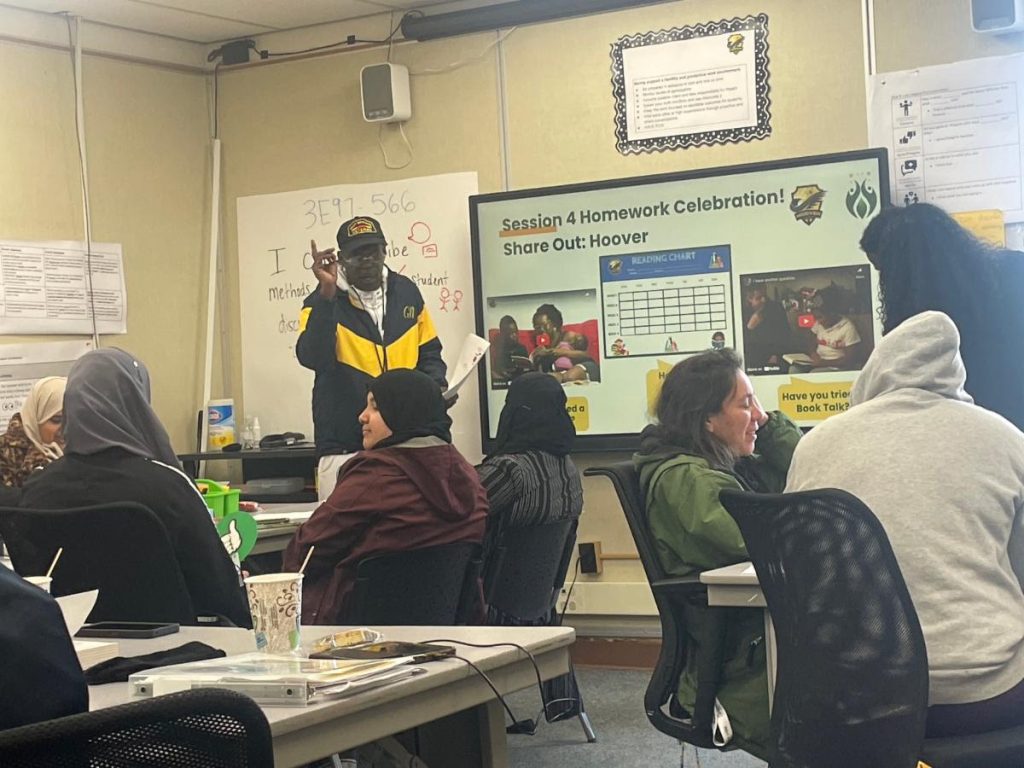
Family Liaison and grandparent Mr Nash leads parents including celebrating how they are using strategies for reading at home.
In the four previous sessions, they built knowledge of the literacy outcomes of their children and other Hoover students, learned strategies to help their children at home, and built power together to make large, positive changes.
The fifth session is called an “Accountability Walk.” The family leaders are here to visit classrooms and observe literacy instruction.
They are asked to keenly observe and take notes they would discuss later. Who is participating in class? Are teachers making sure all students are learning? Are the students responding to the lessons?
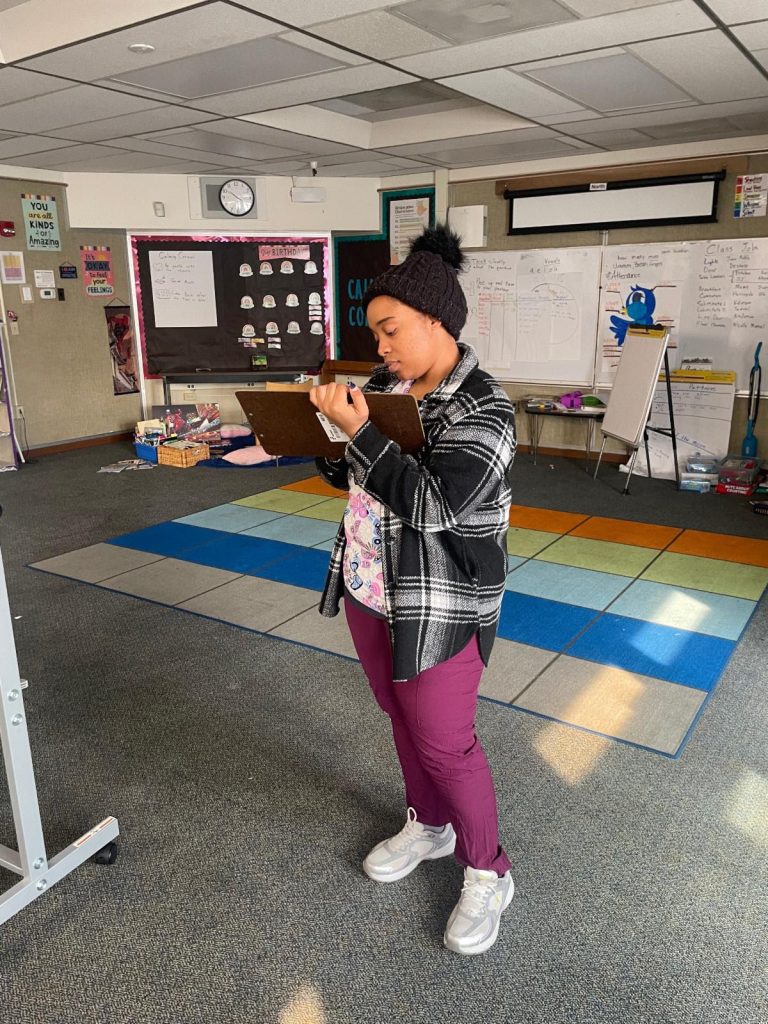
Through observing Kinder instruction at Hoover, parent Brook identified ways she can better teach her daughter at home.
Brooke is the parent of two Hoover students, in Kindergarten and second grade. She says reading to her kids inspired her to get back into reading herself for fun, and she is carrying a paperback fiction book. “I’m really learning a lot,” she says. She’s happy to be here and observe her daughter’s classroom. “This will be fun,” she says.
In each classroom, parents filter into the back to observe. They carry clipboards and take extensive notes. Brooke’s daughter is wearing sparkly gold boots, and the two beam at one another.
In this classroom, students are instructed to write the letter “R.” The teacher demonstrates the proper technique, and students are encouraged to follow along and then practice themselves. “Look at those ‘R’s,’” the teacher tells the class. “Say ‘good job, me!’”
After the family leaders observe four classrooms together, they head back to the portable classroom to debrief. They are encouraged to share what they observed, and they do so in their native language with translation for the rest of the group. What evidence did you see of the teacher teaching? Were the kids getting it?
The family leaders have no problem sharing honest feedback. They ask why one child was sitting alone – are they possibly an English Language Learner student or new to the class? They see children working hard, and express feelings of pride.
They discuss different techniques the teachers were using to keep students engaged, how they would sound out words and have students respond. They talk about strategies they can bring home to support their child’s literacy learning.
FIA Family Organizer Viveca Ycoy-Walton reminds the family leaders that their role is to not only help their child but support other parents. “What do we need other parents to know who are not in this room?”
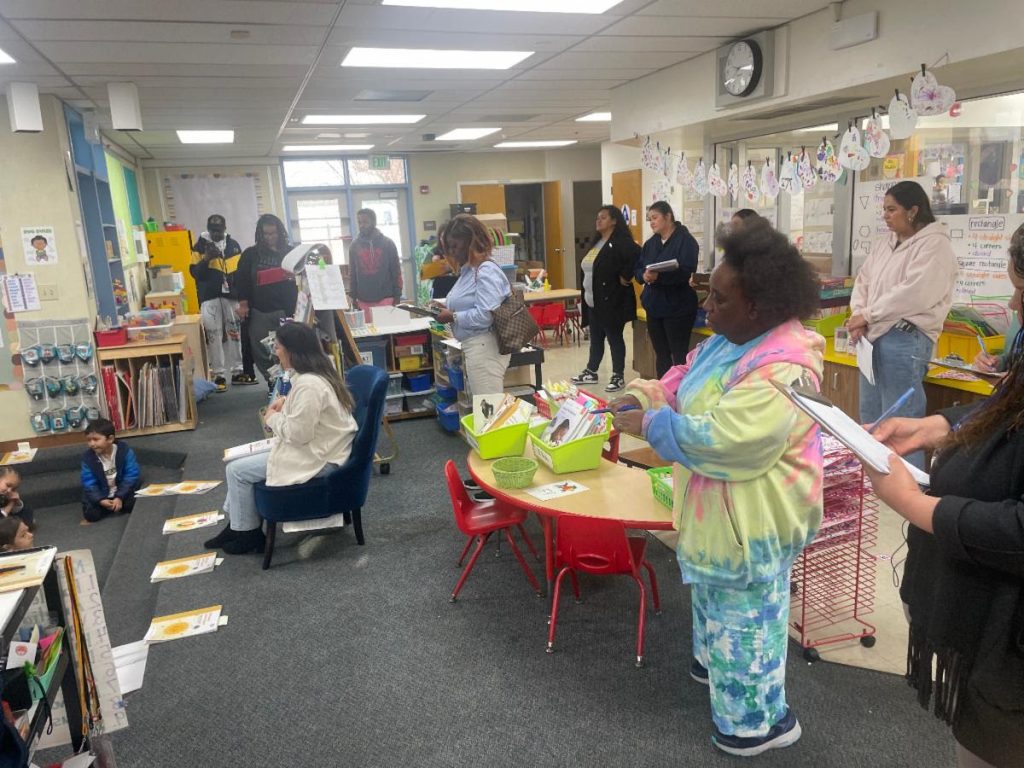
Through Lit for Literacy workshops, parents learned about why a science-based approach to reading matters, then got to observe it in action in Hoover classrooms.
Principal Averhoff later speaks about how the shared experience of observing classrooms together deepens the discussions families can have with each other, and increases their unity as a group. She notes families were comfortable and willing to talk about both the positive and challenging aspects of their child’s education.
“I think families are realizing they have a lot in common with one another and they are building relationships across different groups,” she says. “I’m excited for the families who are here, and also to see what happens when they get the word out to other families. I’m excited to see more family leadership.”
Corwin is one of the Hoover family leaders, and he helped kick off the session in the morning with the fired up group. He’s here with his wife, Diana, and he also brought his mother. Corwin says he’s not a big public speaker so it was a little nerve wracking being up there in front. But it was worth it, he says, “to help other parents learn, too,” he says.
“That’s what a lot of kids need. The stats for our school, you can tell a lot of kids are behind, and teachers can only do so much. Programs like this teach us how to be teachers, or at least try to be, so our kids can excel.”
FIA’s Lit for Literacy (L4L) program aims to improve literacy and academic outcomes for Black and Brown students. With only 20% of Oakland students reading at grade level, FIA developed this program to help families better understand their children’s academic progress and equip them with strategies to support literacy at home. The program includes four training sessions, where parents learn about their child’s performance, gain literacy tools, and develop leadership skills to stay involved in their child’s education. Since its launch in 2022, Lit for Literacy has expanded to 12 schools, and students whose parents participate have shown significant growth in early literacy scores.