When Vanessa Sifuentes looks at her data dashboard and analyzes chronic absenteeism numbers, she sees progress. As Oakland Unified School District’s Deputy Chief of Post-Secondary Readiness and Head of the high school network, she oversees the district’s efforts to combat chronic absenteeism at the high school level, a challenge that worsened after the pandemic.
Chronic absenteeism means missing so much school that a student falls behind academically. In Oakland and across California, a student is considered chronically absent when they miss 10% or more of the school year, which adds up to about 18 days in a typical 180-day calendar.
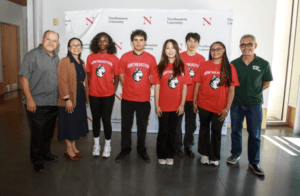 Vanessa (2nd from left) celebrating OUSD scholars who received an Oakland Opportunity Scholarships to Northeastern University with Emiliano Sanchez and Vinh Trinh, OUSD High School Linked Learning Office team members.
From 48% to 33%: How Oakland Schools Are Winning the Battle Against Chronic Absenteeism
“We have been focusing on reducing chronic absenteeism for years,” Sifuentes said. “It was a challenge before the pandemic, and it continued to be a challenge, and was exacerbated by the return to in-person instruction after distance learning.”
The numbers show steady improvement. Across OUSD’s high schools, chronic absenteeism rates have dropped from 48% to 38% to 36%, and currently sit at 33%. While a third of students are moderately or severely chronically absent, two-thirds are showing improved attendance.
“We’re hoping to continue the pattern of reducing chronic absenteeism through a variety of strategies,” Sifuentes said.
Across Oakland public schools, leaders are employing a variety of strategies to bring down chronic absenteeism rates. It remains a vexing issue: 3 in 10 Oakland students are chronically absent, and the rate is even higher for students from vulnerable populations. The rate varies by school — at some schools, the rate is less than 1%, while others the rate is above 50%.
For families and students, the implication of chronic absenteeism runs deep. Students who aren’t in school can’t access the instruction, support, and resources they need to succeed academically. Research shows that chronically absent students fall behind in reading and math, are less likely to graduate, and face steeper odds when pursuing college or career paths. When we talk about Raising the Bar for student achievement, showing up every day is the foundation upon which everything else is built.
Many Oakland public schools have also found something to build on: moving away from a punitive, blaming, and punishment-heavy stance toward a culture of support.
For schools like Lazear Elementary and Oakland Unity High School, and across OUSD high schools, individualized approaches, home visits, and relationship-building are helping bring students back to school. While there is much work to be done, these schools are showing what’s possible when schools and families work together.
 Vanessa Celebrating the launch of OUSD’s partnership with Cal State University East Bay , which provides direct admissions for OUSD students who meet the CSU’s entrance requirements.
How OUSD Is Building a Smarter Attendance System
At the OUSD high school level, a key strategy has been establishing attendance teams at every school. “Attendance can be seen as everybody’s responsibility, and when it’s everybody’s responsibility, it can actually be nobody’s responsibility,” Sifuentes said. So the district identified attendance team leads at each site, typically Community School Managers, who meet weekly with support staff to review data and plan interventions.
The district also shifted from punitive approaches to a focus on root causes. “It’s part of a shift in mindset, shifting the language that we use, because language matters,” Sifuentes said. “How we talk about students and families, and really unearth the reasons why students don’t come to school.”
For targeted groups with high chronic absenteeism numbers, like African American students and students with disabilities, attendance teams bring in specialized staff. Special education case managers assist with communication for students with IEPs, while Office of Equity staff and instructors from African American Male Achievement and Latino Student Achievement courses provide support.
At continuation schools, which serve some of the district’s most vulnerable students, staff conduct home visits in pairs after receiving specialized training. They leave personalized door hangers, also translated into Spanish, when families aren’t home.
“It’s these little strategies that allow us and our staff to make personal connections that really help many students turn it around,” Sifuentes said. “They know when someone cares about them, someone misses them when they’re not at school.”
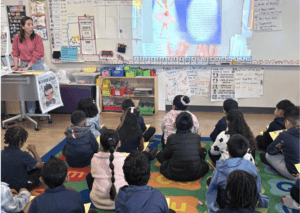 Lazear students in class learning literacy techniques to be at or above grade level.
From 26% to 10% in Chronic Absenteeism: How Lazear Elementary Built an Attendance Culture That Works
At Lazear Elementary, Mario Padilla’s role has focused on attendance during the 10 years he’s worked at the school. Before the pandemic, chronic absenteeism at the school was at 8%. It then jumped to 26%, but has since dropped to 10% in 2024-25, the most recent year data is available.
Padilla credits a comprehensive approach. For new families, he meets with them to introduce attendance policies. For transfer students, he checks in within their first two weeks. For students who have been chronically absent, he meets during registration to set realistic goals. The goal is to see the numbers progress in the right direction.
“If they had 20 absences, our goal is to cut it in half,” Padilla said. “We set an ideal of 10 absences for the coming year. We are realistic with the expectations.”
Lazear also focuses on getting students involved in clubs, sports, and after-school programs. Once students are participating in activities they enjoy, attendance becomes part of the contract for participation. A team of staff members also meets weekly to discuss attendance patterns. And Padilla keeps a watchful eye on the data to spot trends.
“We have different ways of tracking,” Padilla said. “I usually catch on to a pattern right away, like if they’re missing just Fridays.”
When meeting with families, Padilla brings report cards or information from teachers about where students are struggling academically. “Families are very concerned about their kids’ academics,” he said. “I think they just sometimes lose track of the number of days that their kids have been out.”
The reward comes when students struggling with absences turn things around. “Once a student is no longer chronically absent, we hear positive communication from families,” he said. “They’re telling us, ‘this helped, what you did, what the school did.’”
Lazear also keeps attendance visible with signs in front of the school and messages on Instagram. “We’re really in your face, we message about it a lot,” Padilla said.
 Oakland Unity High School students enjoying their day at school!
Catch It Early: How Oakland Unity Stays Ahead of Chronic Absenteeism
At Oakland Unity High School, chronic absenteeism has remained in the low teens, one of the lowest rates among Oakland public high schools.
Assistant Principal Keisha Stephen noted that this year has brought new challenges.
“I do feel like there’s a sense of fear for a lot of our undocumented students with things that are going on in the world,” she said. “Families are feeling the pain of potential removals, and I have seen it more as a reason for why we’re seeing some portion of absenteeism.”
In response, the school has held one-on-one meetings with parents and small groups to reassure them. “We’re doing everything we can to keep them safe,” Dean of Students Nathan Castro said. Staff also have regular discussions about their protocols.
Unity runs attendance reports every week. Once a student’s absenteeism rate reaches 8-10%, they make a call.
“You’re better off getting on top of it as soon as possible,” Castro said. “We’ve come to notice that once it hits about 20 to 25%, the odds of them coming back and returning full-time to school are low. So we try to catch them earlier.”
When they reach out to families, Castro notes that the approach matters. “It’s different when you’re getting an automated message from the office saying that someone was not at school, as compared to a call from an administrator,” he said. The call isn’t like, ‘Why isn’t your kid here?’ It’s literally, are they okay?”
Rather than punitive measures that might push students away, Unity focuses on removing obstacles.
 Oakland Unity High School girls volleyball team!
“If you haven’t been here and now you have detentions for not being here, the odds of you wanting to come are even less,” Castro said.
The school offers tutoring to help students who feel behind to catch up. Administrators will visit students and families in their homes to get to the root of the problem. Castro has even called students every morning for weeks as a wake-up call. “A simple text message can go a long way,” he said.
Understanding each student’s situation is key to the individualized approach.
“These are human beings, and every human being has a different kind of story and journey, so we have to get to know them and build that relationship,” Stephen said. “We’ve even had parents work with other parents because parents were struggling on what they should tell their child at 14 who’s refusing to come to school.”
Castro emphasized supporting the whole family. “A lot of times the issues are deeper than skipping school,” he said. “Students are a piece of a family, and their attendance is a reflection of what a family may be going through.”
Creating a culture where students want to be at school matters most.
“If you create a space that they genuinely want to come to, a place where they’re benefiting from, they feel safe, they feel comfortable, they feel supported, that all lends to, why would I not want to be there?” Castro said. “We have kids who hang out here till 5 pm every day playing because they like it here and they feel safe.”
Sifuentes agrees that to lower chronic absenteeism rates, schools need to be places that students want to be.
“We want to make sure that schools have events and classes that make students feel joyful, that make them want to be at school every day, and where they feel safe,” she said. “We want students to know that they have lots of adults in their corner to help them make the way to school every day as often as possible.”
 Click here to read our latest Data Report!