We recently sat down with OUSD’s Deputy Chief of Post Secondary Readiness, Vanessa Sifuentes, to get an update on the district’s strategy and what families need to know.

Vanessa (right) At OUSD Leadership Institute with OUSD HS Deputy Network Superintendent for Continuation and Alternative Schools , Han Phung (left).
Confronting Systemic Barriers
When she looks at Oakland’s A-G completion rates, Vanessa Sifuentes sees a bit of her own story. For Sifuentes, this work is professional but also deeply personal. She’s the daughter of Mexican immigrants, and she knows how educational attainment can help break cycles of generational poverty.
“I really believe in the power of what we do in our schools,” she said. “It really can change outcomes for kids.”
She visits school sites to connect with school leaders, principals, and students, and to experience the work first-hand. “It’s nice to put faces and people to the numbers.”
The students she encounters often have to navigate a maze of systemic barriers. Sifuentes was candid about OUSD’s challenges, pointing to “structural inequities that are exacerbated by issues of poverty, issues of structural racism,” she said. For newcomer students, the hurdle can be even higher. “Language in and of itself, like learning to acquire English while also acquiring academic credits… these are barriers that are hard for students to navigate independently,” she said.

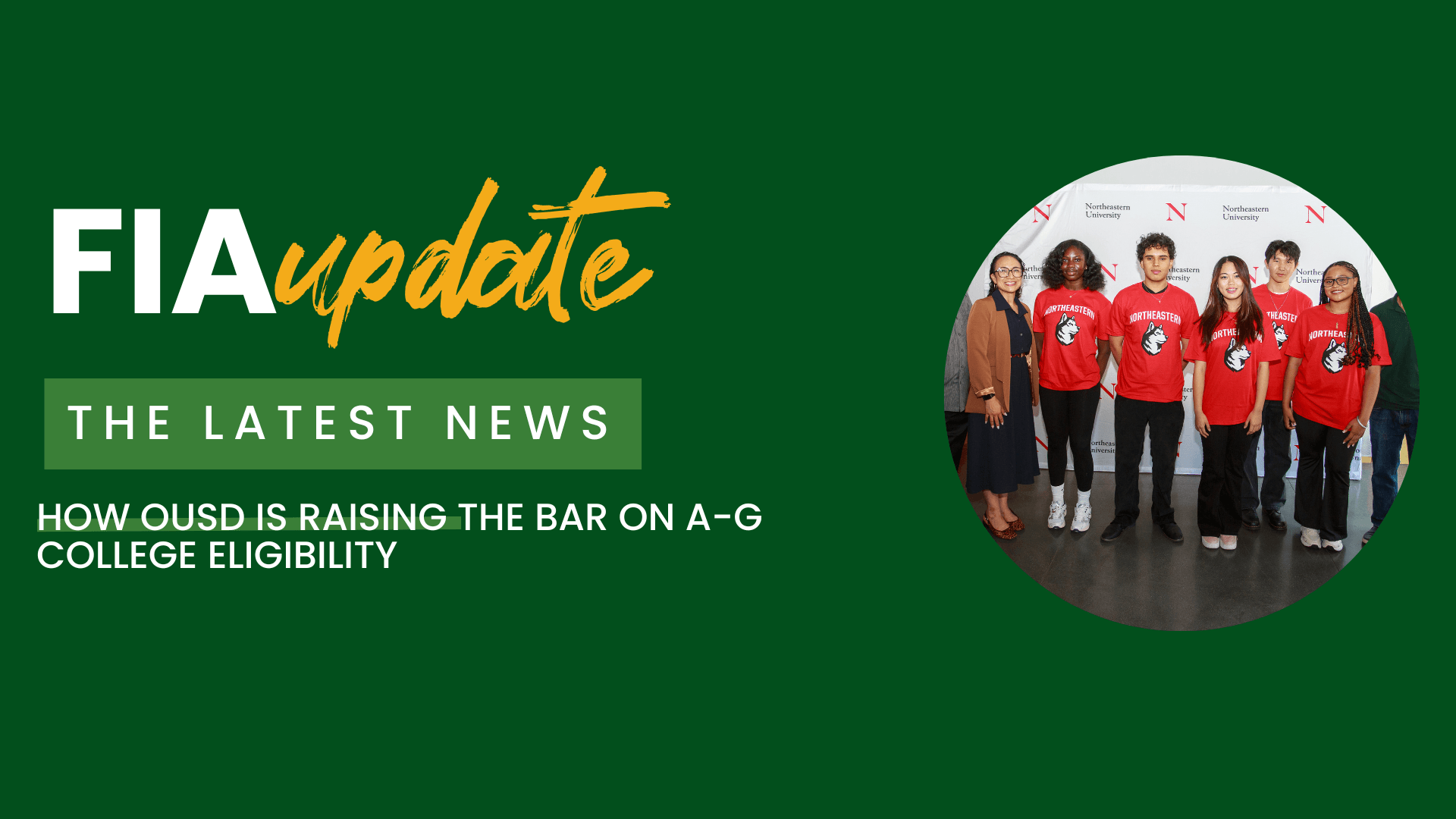
Vanessa (2nd from left) celebrating OUSD scholars who received an Oakland Opportunity Scholarships to Northeastern University with Emiliano Sanchez and Vinh Trinh, OUSD High School Linked Learning Office team members.
OUSD’s A-G Strategy Shows Results
Sifuentes said there are signs of success. This is her 11th year at OUSD, and she has seen a positive trajectory over the last decade, with especially strong momentum building over the last couple of years. The success is across all student groups “across the board,” she said.
“A to G (eligibility) is going up,” she said. “All the numbers that need to go up are going up. All the numbers that need to go down are going down.”
She attributes this positive trajectory to a district-wide strategy that includes system fixes and targeted interventions. Addressing operational errors was a key step — conducting “a lot of technical cleanup as well to make sure that our students are getting credit for the work they are doing for classes that are A to G eligible,” Sifuentes said.
This progress is also evident in district-wide data. Between 2021 and 2024, A–G completion rates increased by 4.7% for African American students and 10.7% for Latino students. School-level data shows even more significant gains. For African American students, A–G completion rates rose at Castlemont (+22.5%), Coliseum College Preparatory Academy (+13.9%), McClymonds (+18.4%), Skyline (+11.3%), and Madison Park Academy 6–12 (+28.3%). During the same period, Latino students also made strong progress, with increases at Fremont (+13.7%), MetWest (+11.9%), Oakland International High School (+23.1%), and Oakland Tech (+10.9%).
To help students get back on track, OUSD has created a centralized team of teachers who provide A-G eligible recovery courses in subjects such as English and Algebra. This team deploys to schools that need the most support. She said that the district is also working to prevent failure from happening in the first place with “Ninth-Grade Success Teams” at comprehensive high schools. “The more we can interrupt those patterns earlier, the more options our kids will have,” she said.
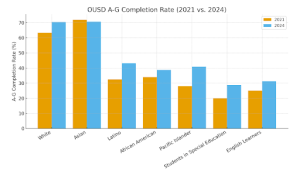
A-G Completion rates for OUSD by different subgroups between 2021 and 2024
The Work Ahead: Personalization, Accuracy, and Family Partnership
She emphasized the importance of family partnerships as well. Last spring, OUSD piloted a program to directly inform families of 10th and 11th graders about their A-G status, which is a shared priority between OUSD and FIA’s demand to put students and parents in the driver’s seat.
“We want to make sure that we are in communication with families,” she said. “We strive to make sure that student and parent voice are central.” She explained that parent feedback has already driven several system improvements, including renewed efforts to improve access for students in Special Education. For example, when parent leaders highlighted that students with IEPs were not fully accessing key pathway programs, the district began addressing this disparity. “Parents played a huge role in that for us,” she said.
Still, there is much work to do. “We are also very aware that we still have room to grow,” she said. “The next phase of the work is really about personalizing it for the students that we’re not yet reaching — that’s someone’s son, someone’s daughter, someone’s grandchild. Everybody matters.”
A critical challenge in tracking A-G success for OUSD is how it is measured by the state: only through the four-year cohort rate. This means a student is only counted as A-G eligible if they complete all requirements and graduate within four years of starting ninth grade.

Celebrating the launch of OUSD’s partnership with Cal State University East Bay , which provides direct admissions for OUSD students who meet the CSU’s entrance requirements.
If a student leaves OUSD and does not re-enroll elsewhere, they are essentially lost to the system, which negatively impacts the cohort A-G rate. Sifuentes said that only raises the urgency of ensuring students are accumulating the proper credits on schedule.
“Our staff will follow up with that student and family, but if they don’t re-enroll somewhere, they kind of fall off of our radar, and that has a negative impact,” she said.
Despite the systemic challenges, Sifuentes believes that a multi-pronged strategy of prevention, intervention, and family partnership will show measurable results. She believes the ultimate success of this work depends greatly on sustained collaboration between the district and the community. Family voice remains absolutely critical.
“We strive to make sure that student and parent voice is central and continuous to our work,” she said.

To see more Oakland student data from the 2024-25 school year, click the photo above to read FIA’s Raise the Bar Report.