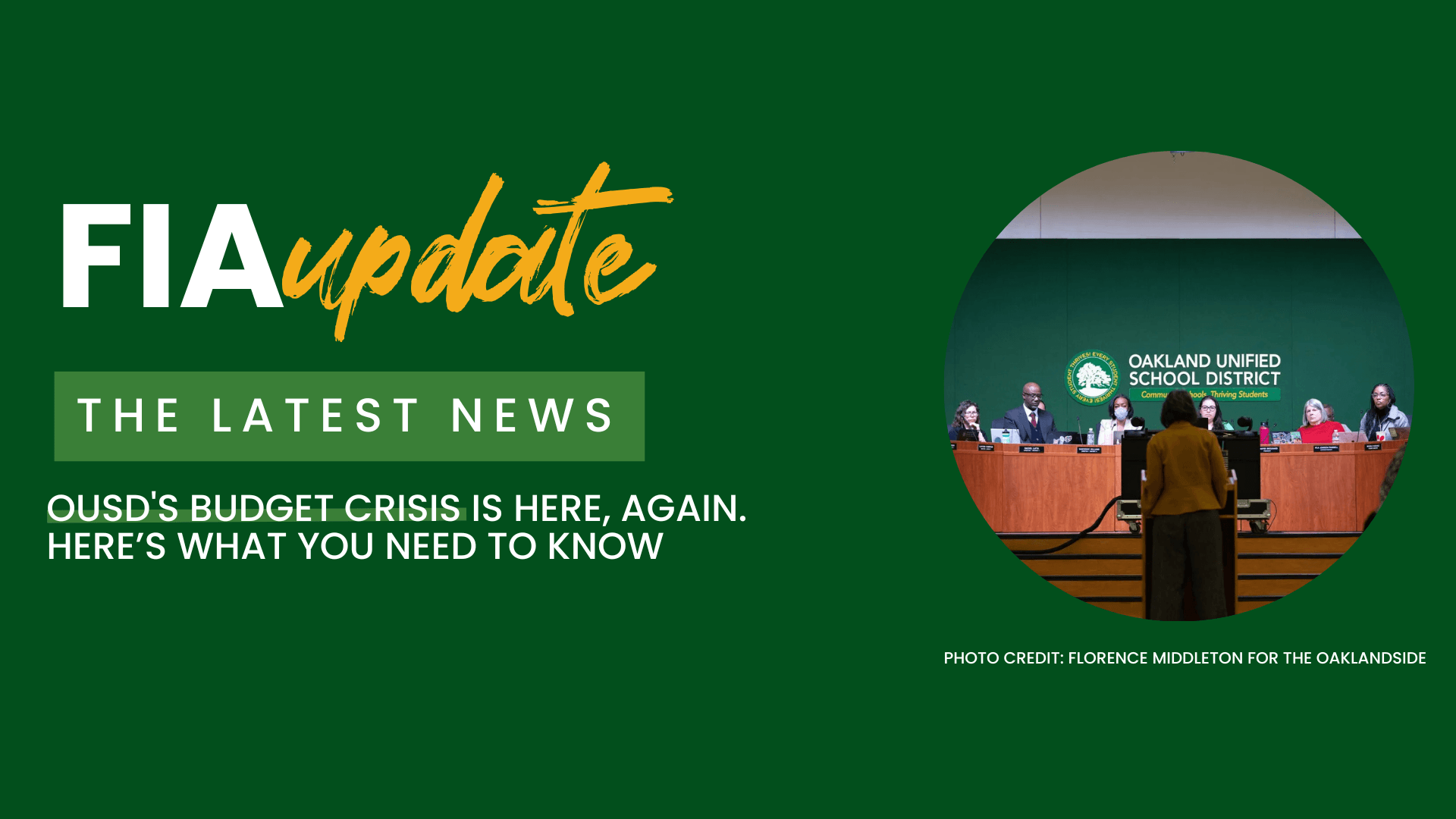
As we settle into the new school year, the Oakland Unified School District (OUSD) has received sobering financial news that every family needs to understand. The annual process of “Closing the Books” on the previous fiscal year is complete, and the numbers confirm the district is facing a severe and urgent budget crisis.
The “Closing of the Books” is a process in which every dollar from the previous year is accounted for, establishing the starting balance for the new year’s budget. The district is at a critical financial crossroads, with its financial cushion rapidly disappearing.
Just one year ago, the unrestricted general fund balance stood at a robust $118 million. Today, after closing the books on last year, that number has fallen to $55.8 million. The core operational fund, the money used for the day-to-day functioning of the district, is now just $3.4 million. That’s a 53% decrease in just one year, a clear indicator that the district’s finances are moving in the wrong direction.

OUSD’s Chief Business Officer, Lisa Grant-Dawson, presented the Closing of the Books at the September 10 school board meeting. She shared that the district is deficit spending, meaning it is spending about $4 million more each month than it receives in revenue. This discrepancy is caused by a number of factors. One such factor is a lower-than-projected student attendance rate; state funding is based on ADA (average daily attendance), and lower rates of attendance have cost the district $2 million out of the budget.
There were other significant costs, including new bargaining agreements, the restoration of after-school programs, and a $10 million increase in special education funding, CBO Grant-Dawson shared. The one-time funds used in previous years to balance the budget have also run out.
In a recent annual report on the district’s finances, Alameda County Superintendent Alysse Castro framed the crisis as a failure of decision-making. Despite OUSD operating under full local control for the first time in a generation, “the same fiscal and decision-making issues that have plagued the district for many years remain,” Castro wrote to the school board. Castro detailed how the school board’s failure to act on measures that would save the district a lot of money, like the plan to merge schools as well as backing off taking action on its own planned cuts, has pushed OUSD toward the risk of running out of funds this academic year.
The state mandates that school districts maintain a reserve fund of at least 2%, and the OUSD board has its own stricter policy requiring a 3% reserve, which is about $28 million. The current projections, based on this new lower starting point, show that the district is on a path to fail to meet even the state’s minimum requirement by next June.
As School Board Director Clifford Thompson shared during a recent meeting, “We’re at a dire point that if we don’t watch out, we’re going to sink again.” If the district becomes insolvent, it risks falling back into state receivership, a loss of local control that would undo the hard-won independence achieved just a few months ago.
The Board of Education now has to make decisions to steer the district toward solvency. Staff has been directed to return with a set of strategies by the October 8th meeting. Some board members have advocated for taking options like school closures or layoffs off the table, while others caution that everything must be considered.

FIA family and youth leaders alongside the Oakland NAACP and the Latino Action Network
Earlier this year, and FIA Family and Youth Leaders, the Oakland NAACP, the Latino Action Network, and other community groups demanded more transparency in the district’s budgeting decisions, and outlined key demands:
- A balanced budget that prioritizes student needs
- More community voice in leadership decisions
- A real commitment to student outcomes
The next few months will require the engagement of families to overcome this enormous challenge. The choices made will define public education in Oakland for years to come. We must hold leadership accountable to ensure that the path forward is chosen with the best interests of students.