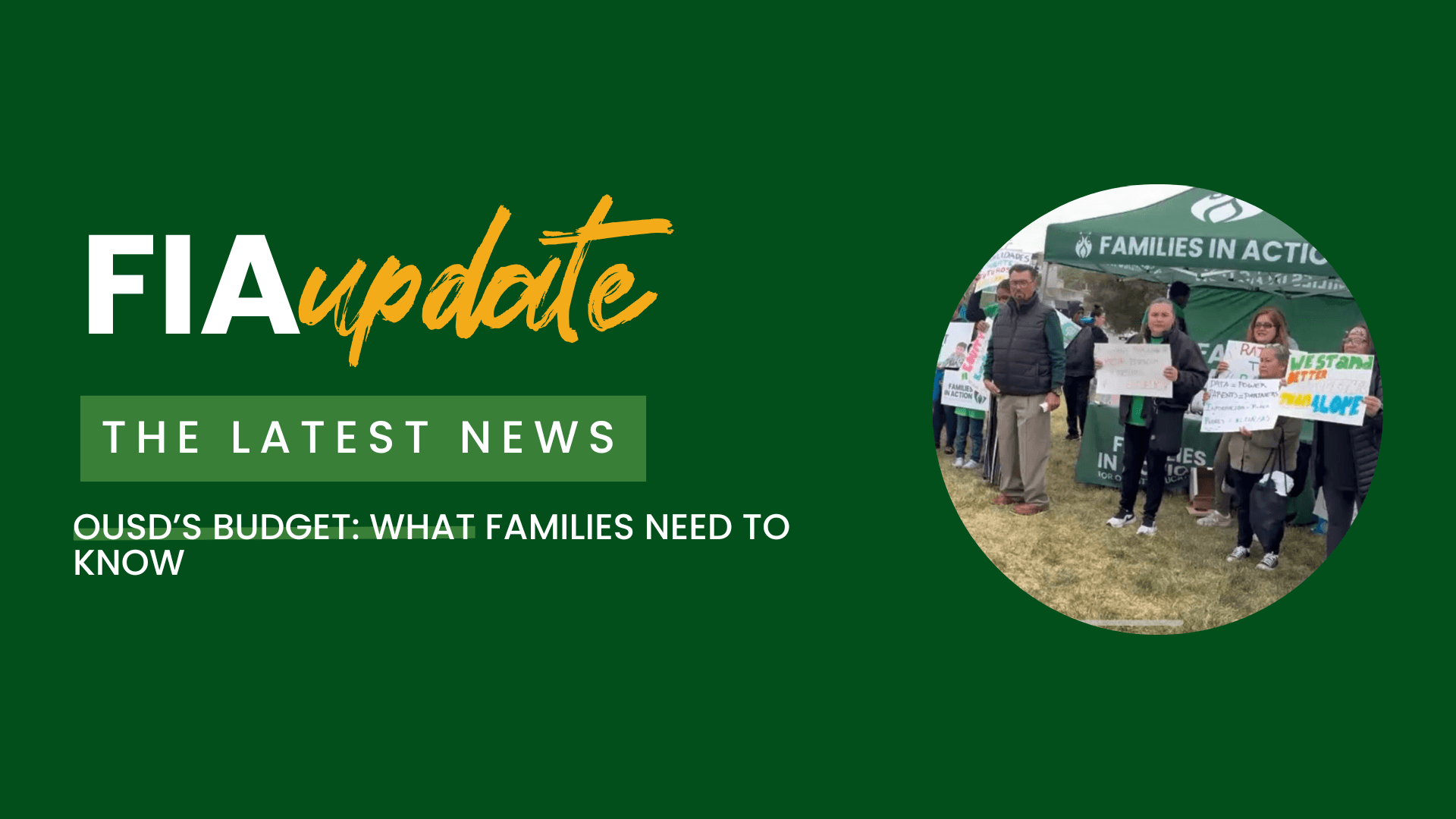

Oakland Students joined FIA’s march to demand more to OUSD’s board in Spring 2025.
For more than two decades, Oakland Unified School District’s finances were monitored by state and county overseers after a financial collapse in 2003 led to a $100 million state bailout. Now, as OUSD has finally exited state receivership, families face a critical question: Is the district ready to stand on its own financially?
The answer, according to recent budget reports and county officials, is that the district is still teetering on the edge of a financial crisis. While OUSD has made progress in cleaning up its financial systems and will soon pay off its massive state debt, Alameda County Superintendent Alysse Castro warns that deep structural challenges remain. In an April letter to the board, Castro noted that despite improved fiscal controls, OUSD still grapples with “declining student enrollment, historical over investment in micro schools, and billions of dollars in deferred maintenance needs.”
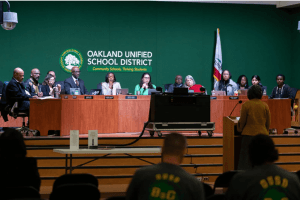
Alameda County Superintendent of Schools, Alysse Castro addresses the OUSD school board. Credit: Florence Middleton (this image is from the Oaklandside)
Castro also noted in the letter that there are “huge disparities between OUSD’s very high per pupil revenue and the district’s very low pupil performance.” This sends alarm bells ringing for families regarding how the district is allocating resources. The district’s spending priorities are clearly not aligned with supporting better educational outcomes for students. When the school board approved the 2025-26 budget in late June, it did so with what Chief Business Officer Lisa Grant-Dawson called “no margin for error.” The $329,000 cushion above the required reserves means any unexpected expense, such as rising special education costs or emergency repairs to a school campus, could force immediate cuts. The county’s review of OUSD’s second interim budget paints a grim long-term picture. Without significant changes, the district faces a $78 million deficit by 2026-2027. In the letter, Castro’s office emphasized that because the district “may or may not” meet obligations language in their qualified certification means outcomes for OUSD range “from a positive certification to bankruptcy.” Castro noted that OUSD has many under-enrolled schools, and maintaining these campuses drains resources. OUSD has 77 school sites, despite an efficiency analysis suggesting it should only have 46. But past attempts to consolidate schools have been met by fierce resistance. The school board abandoned the most recent proposal to merge 10 campuses. Year after year, OUSD has relied on temporary fixes to balance budgets, such as COVID relief funds. Grant-Dawson warned this approach is unsustainable: “We know where the answer is,” she shared with the board. “We’re going to have to reduce programs and we’re going to have to reduce staffing.” The board’s decision in the spring to part ways with Superintendent Kyla Johnson-Trammell eight months after extending her contract, which was followed by approving a $357,000 deal for Interim Superintendent Dr. Denise Saddler.

FIA, NAACP, and Latino Education Network Partnering for Oakland Students.
This has raised questions about fiscal priorities, and FIA Family and Youth Leaders, the Oakland NAACP, the Latino Action Network, and other community groups have demanded more transparency in these decisions, and outlined key demands:
- A balanced budget that prioritizes student needs
- More community voice in leadership decisions
- A real commitment to student outcomes
As OUSD transitions to full local control, Castro’s office has been clear: The safety net is gone. “Nobody’s coming to say a word,” Grant-Dawson told the board. “They’ll just be watching.” The end of receivership should be a celebration of Oakland’s resilience. But as Castro’s office cautioned, paying off the debt is like “paying off your car loan… but the car is in the same condition.”

Click our video to see how we organized and demanded for a better Oakland!
Whether OUSD’s independence from state receivership leads to financial stability or another crisis depends on choices being made right now. It won’t matter if the school board keeps applying budget band-aids instead of real fixes and if its spending continues to not prioritize educational outcomes for Oakland’s students. Families and students have the most at stake and deserve both a seat at the table, meaningful participation in budget decisions and full transparency about the challenges ahead.