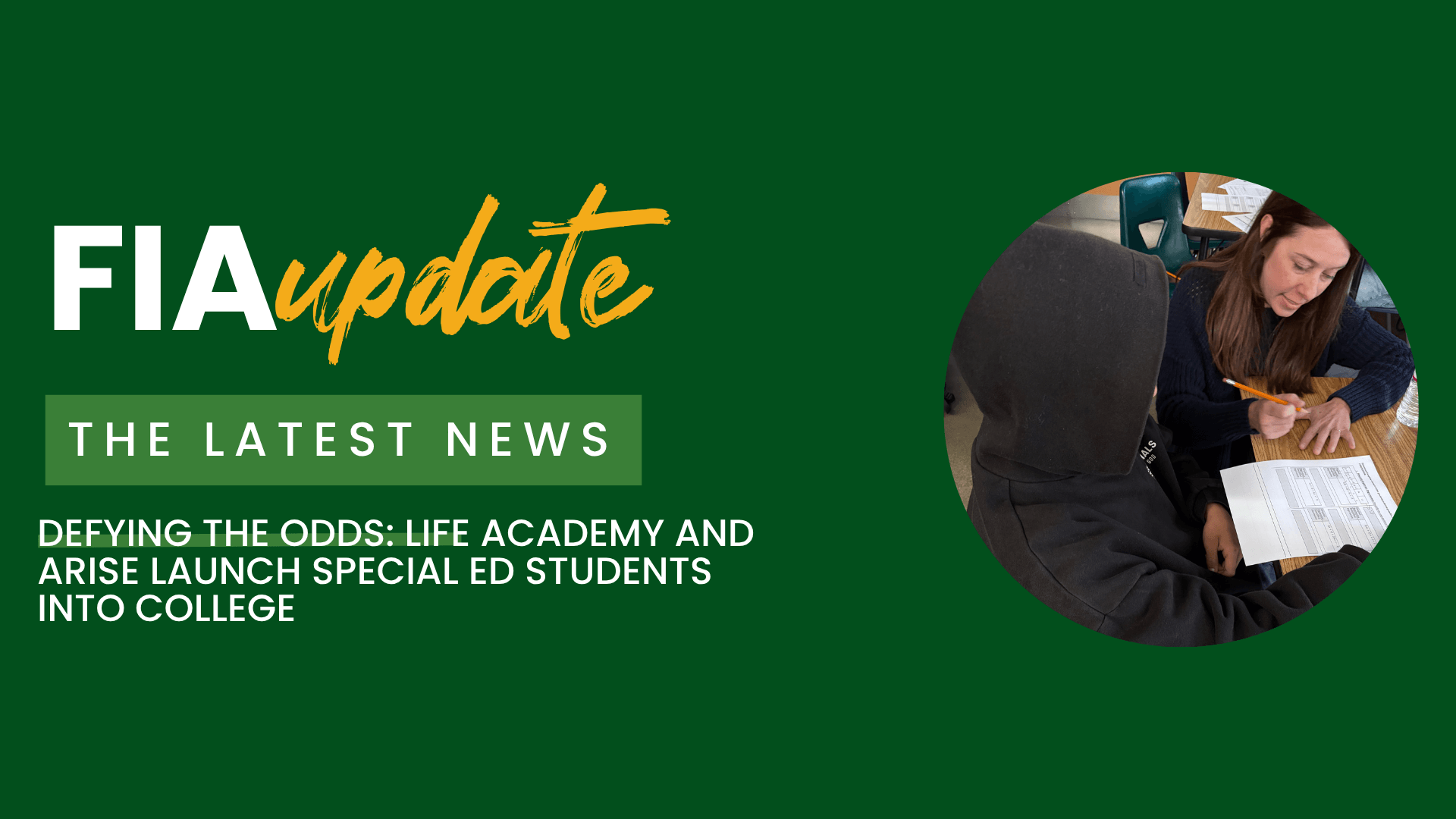
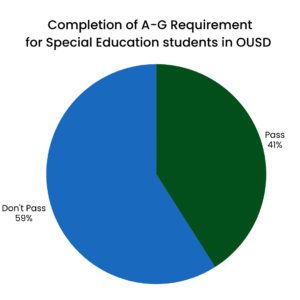
For many Special Education students in Oakland public schools, getting into a four-year college is a long shot. In FIA’s 2025 Raise the Bar Report, data shows that only 41 percent of Oakland special education students complete their A-G requirements. Compare that to other student populations: for white students, that number is 72 percent. For Asian students, it is 75 percent.
That is not true of all public schools in Oakland, however. There are bright spots, schools that are raising the bar for all students. At ARISE High School, 100 percent of special education students are completing their A-G requirements and gaining UC and CSU eligibility. At Life Academy of Health and Bioscience, the rate is 98 percent. How? Staff and school leaders point to specific, replicable practices. Their strategies offer a roadmap for schools across Oakland.
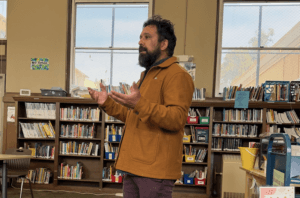
Alykhan in the Calvin Simmons Library at LIFE Academy
Life Academy of Health and Bioscience
Alykhan Boolani has been at Life Academy for eight years. The school serves about 440 students. He knows every name.
“What’s true about a small school is that you can hold an entire community in your head,” he said. “Knowing kids’ individual stories, knowing their families, knowing their connections to one another.”
Life Academy takes being small seriously. About 20-22% of students receive special education services. That is roughly 74 students. The school uses an inclusion-based case management model.
“Students may have a pull-out space (a specialized space for targeted interventions) that they work with their resource specialist individually, but for the most part, it’s a push-in model (in-class support),” Alykhan said. “You’re in the classes, you’re having a parallel experience to everyone else at the school while getting your needs met.”
Students with IEPs have multiple adults watching their progress. Resource specialists, counselors, and advisors all work together.
“If you are a student with an IEP (Individualized Education Program) and you have this very specific, individualized plan, you’re going to have three people circling you to keep eyes on you,” he said.
The school monitors transcripts constantly. Advisory groups of 20 students do transcript reviews during parent conferences. There are no D’s at Life Academy. The idea is that no one should fall through the cracks.
“Our job is to open doors,” Alykhan said. “When you’re in ninth grade, you may not want to go to college right now; you could be thinking about a trade. But we’re not going to eliminate the choice.”
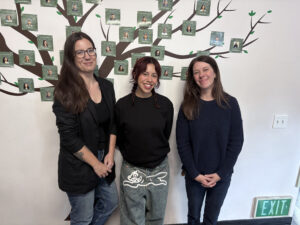
Karla Gandiaga (left) and Robyn Collignon (right) at ARISE High School
ARISE High School
Walk into a classroom at ARISE High School, and you’ll usually see two adults in the room.
The teacher is leading a lesson. The other is an academic mentor, and “95 percent of the academic mentors are ARISE alumni that are either in college or have graduated college,” said ARISE Head of School Karla Gandiaga.
The academic mentors are not paraprofessionals, and they are not fulfilling IEP minutes. They are there for every student, but special education students especially benefit from the extra attention.
What makes this model powerful is who the mentors are. They are cousins, neighbors, and former students who have sat in the same seats. They know the neighborhood, the families, and what it takes to navigate high school as an ARISE student. That shared experience translates into a depth of insight and empathy that is difficult to manufacture, and it shapes how they show up for the students they support.
Robyn Collignon, ARISE’s Director of Special Education, said special education students benefit from the additional support of another adult in the class, as well as the data collected on where each student is in their learning. In addition, education specialists provide much needed services for students with IEPs.
“They benefit from the re-teaching that happens,” she said. “Maybe they have some gaps going into a test, or gaps that a test reveals that an Ed Specialist can help fill.”
The school employs six full education specialists. Many schools use fewer specialists and rely on paraprofessionals instead. ARISE made a different choice.
“It is very different to be receiving your service minutes from your case manager that has written your IEP and has a credential in special education,” Karla said.
The academic bar is set high. ARISE requires more than A-G eligibility. Every student takes two dual enrollment classes, completes an internship, and does public presentations of learning in 10th and 12th grades.
“The starting point is that everybody’s on the ARISE grad track which is more rigorous than A-G,” Karla said.
But the school also works to meet students where they are.
“We want every student in the class that will actually move them forward,” Karla said. “For a student reading at a first-grade level, that’s a focused reading intervention, where they can build foundational skills and experience genuine progress, rather than English 4.”
Family meetings happen every month by grade level, where families learn about graduation requirements, college applications, career, and financial aid.
“Our families are really hungry to support their students in their college and career journey,” Karla said.
Nataly Moreno, an Education Specialist and ARISE’s 504 Coordinator, noted how the school’s college course requirement benefits special education students.
“I’ve seen a lot of my students in special education excel in college courses,” she said. “It makes students feel more confident in themselves and build more autonomy in their education.”