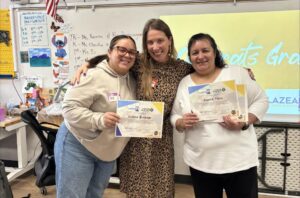
 Loreana (left) receiving her certificate for completing the Lit for Literacy Program! Lazear Principal Kaitlin Friedman (center) and Family & Community Coordinator, Rocio Gonzalez (right)
Building Readers, Building Roots
Loreana has two boys at Lazear Elementary, one in kindergarten and one in second grade. This is her third year as a Lazear parent, and she knows what brought her back to the Lit for Literacy program session on this weekday morning.
“So, one: I have boys, so I have to be on top of what they are doing,” she said with a knowing smile. “And two, I feel like when your kids understand the basics of reading and writing, no one can take that away from you.”
Loreana also thought about her own parents. Her mom was involved when she was growing up, but not like this. “I never saw her in the classroom,” Loreana said. “It was more like as a parent leader with events after school. I want to show my kids that I’m here to support them.”
Loreana was on campus with other Lazear parents participating in the Family Accountability Walk, the final session of the school’s Lit for Literacy institute. The program is now in its fourth year of a partnership between FIA and Education for Change public schools. And it has grown steadily each year.
Susan Singleton, FIA Family Organizer and Associate Director of K-5 Organizing, has been there each step of the way. Over four years, about 300 families from Education for Change public schools have participated in the program. Susan said she sees the Lit for Literacy institute as exactly what families need to take that first step.
“There is the excitement of just seeing such a tremendous amount of parent participation as a result of the institute,” she said. “It’s a really good baseline launching pad for parents to get involved at their child’s school.”
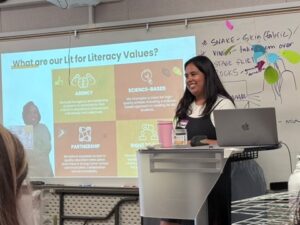 Families in Action organizer, Paulina Sepulveda, going through a session of the Lit for Literacy Institute.
From Session to Classroom
At Lazear, Paulina Sepulveda, FIA Family Organizer and Charter Renewal Lead, set the tone for the morning as parents gathered. “We’re going to be in classrooms to observe everything that we’ve been learning in these sessions,” she told the group of parents. “Some of these strategies, like the book walk and book talk, you’ll actually be able to observe that and see how teachers are supporting their students in the classroom.”
Principal Kaitlin Friedman welcomed the parents and gave them the lay of the land. They would visit TK and first grade and observe a small-group tutoring session with a teacher who works with older students on foundational literacy skills. “We serve readers of all levels, and we want to meet kids where they’re at,” Friedman told the parents.
She also took time to walk parents through the five pillars of literacy: phonemic awareness, phonics, fluency, vocabulary, and comprehension. And she offered a reminder: “All this does not need to be built in English,” Friedman said.
“These are for any language that you are speaking at home, so keep using it,” she continued. “You are building your child’s vocabulary, their comprehension, all of it. Reading in Spanish is great. Do not feel like you need to know English. It is language agnostic.”
Parents then headed out into classrooms with instructions on what to look for: instructional materials, teacher role, student role, and evidence of data use. They returned with observations and questions.
For Loreana, the TK classroom stood out immediately. “The teacher was asking them, where do you start reading from?” In the kindergarten class, she noticed the structure of small groups and computer time. “I was wondering who’s getting up and supporting these students while the teacher is helping the smaller groups?” she said.
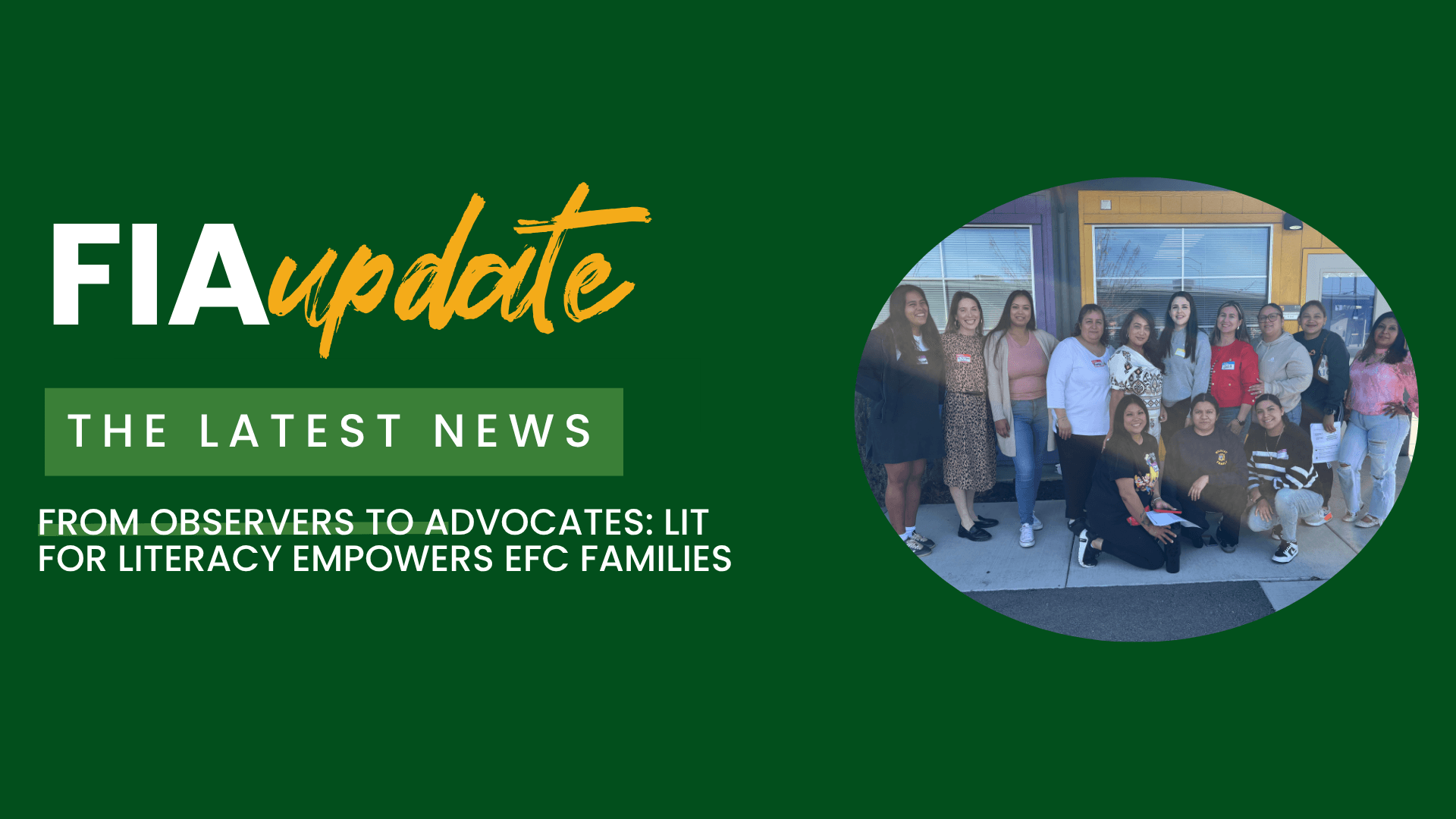
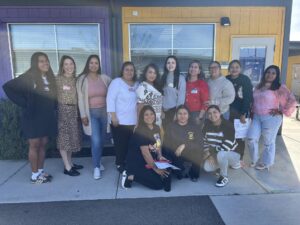 FIA parent leaders at Lazear!
In a first-grade class, she watched the teacher break down a single paragraph, asking students to pull out the who, the what, and the basic information they would need to write their own book later. “She reread and had the students connect with each other and as partners for them to pull that information from each other and then share it out loud,” Loreana noted.
This was Loreana’s first time actually staying for a full classroom visit. She usually comes to Coffee with the Principal, but then has to leave for work. “It was interesting and it kind of sparked something for me,” Loreana said. “Like, oh, yeah, I can do this at home, too. For example, if I see my kids having issues with reading, I can do flashcards.”
She also appreciated being there with other parents. “It’s good because I’m not the only one learning,” she said. “There are other people here because they care about their children’s education, and they want to help too.”
Amphil, another parent in the group, had a similar reaction. With six children ranging from high school to a one-year-old, she came looking for new strategies. “For my first one, homework was really easy, reading was really easy,” she said. “But with my kid in kinder, I noticed he was having a lot of issues reading. So the institute helped see how I can be more present, and gave me a lot more different strategies.”
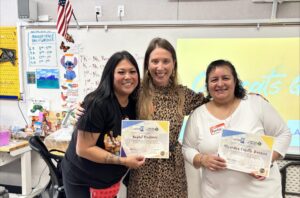 Amphil (left) receiving her certificate for completing FIA’s Lit for Literacy Institute!
Sharing, Growing, and Imagining What’s Possible
The experience also pushed her outside her comfort zone. “I’m very shy, I’m an introvert,” she said. “(Lit for Literacy) allowed me to reach out a little bit more, branch out more, and share with other parents, too.”
In the debrief, parents shared what moved them. One parent got emotional watching the English learner tutoring session. “It was very relatable,” she said, remembering when she was young and learning English.
Another noticed how teachers used tools and charts instead of just giving answers. “The kids had to figure it out for themselves,” she said. A parent suggested a classroom phone book so parents can reach out to each other.
For Friedman, hearing feedback from families is a reason why she does this work. “Partnering with families means actually really leveraging them to provide the information that we need to best support their children, to best help us think about how to get more families in, what to share at home,” she said.
As the session wrapped up, Paulina invited parents to the upcoming citywide Lit for Literacy celebration in May, where families from all 15 schools in the program will come together to share what they’ve learned.
“Imagine if this room had 30 parents,” she said. “What could be possible? Could we reach our goal of 100% of Lazear students reading on grade level?”
Loreana left with new tools and ideas, and she said she was thinking about how to practice D and B sounds with her son at home, as well as how to help other parents get involved.
“To tell the truth, if I hadn’t been called by another parent, I don’t know if I would have come,” she said.