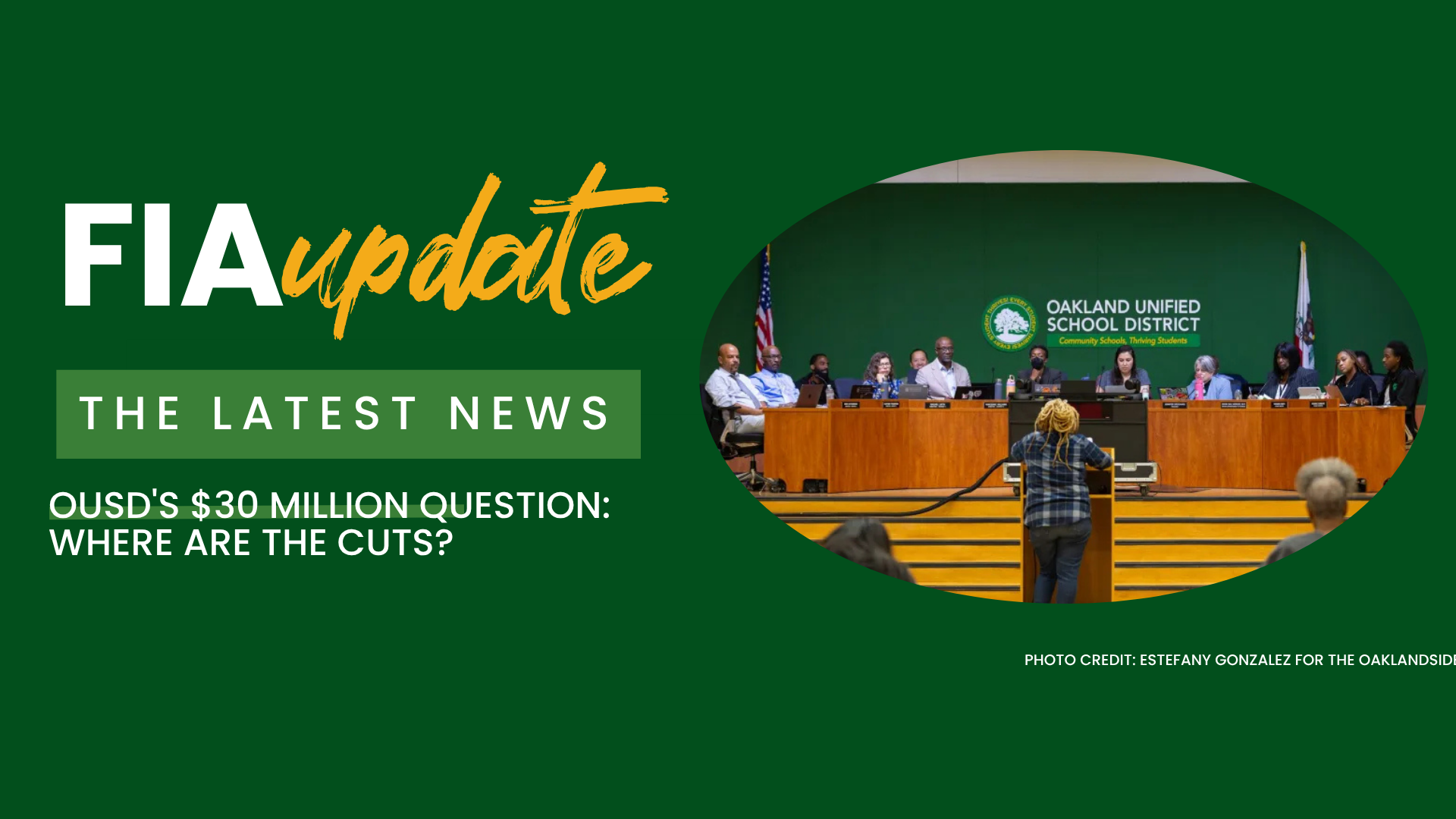
The Oakland Unified School District is receiving more money from the state than it initially budgeted for, improving its current financial outlook. But that doesn’t mean tens of millions in yet-to-be identified budget cuts will be avoided this year, or that the long-term financial future of the district is looking any better.
At its first meeting of the new fiscal year on August 12, OUSD’s budget update is $22.9 million healthier than projected in June, thanks to state funding increases including $8 million more from LCFF, up to $18.5 million in one-time block grants, and $12 million from a higher special education reimbursement rate.
But most of this is one-time money, while costs for special education, labor, services, and risk management keep rising.
Recent news reports also claim OUSD received a negative credit rating outlook for the current fiscal year, citing several factors, including ongoing fiscal pressure, the loss of unrestricted reserves and uncertainty over the district’s ability to restore fiscal stability.
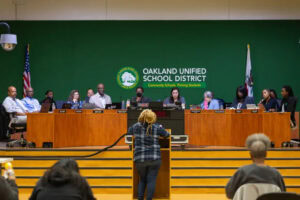
Picture credit: Estefany Gonzalez for The Oaklandside | The OUSD board of Directors listening to a parent
Projected deficits remain at $46 million for 2027-28 and $40 million for 2028-29. And the district closed the 2025-26 fiscal year with a $22 million deficit, while also announcing a fiscal stabilization plan (Superintendent Denise Saddler’s roadmap to remaining fiscally solvent) that included $30 million in cuts planned for the 2026-27 fiscal year.
Where those cuts are coming from has not been identified. That fiscal year is now underway and even with the additional state funding, the $30 million in cuts this year remains the plan.
“While reducing (the amount of cuts) to a different number might be something that might be mathematically possible, we’re aware of other expenses that are on the horizon,” Troy Christmas, OUSD’s director of strategic projects, said at the meeting.
Where those cuts will come from remains unclear. When the board passed a $1.2 billion budget for 2026-27 in June, Saddler and district staff shared that the district had both a $22 million deficit and an $8 million surplus.
How can both be true? Director Mike Hutchinson (District 4) repeatedly asked staff that exact question.
“We can’t have a surplus and a balanced budget at the same time as we have a deficit,” Hutchinson said. “All through this document, it references deficits. So how can we say there’s a balanced budget? You cannot have a surplus and a balanced budget at the same time that you have a deficit.”
At the Superintendent’s direction, staff responded to Hutchinson that while there is a $22 million structural deficit, the plan is to cut $30 million in 2026-27, which would create an $8 million surplus.
OUSD says it is stable enough to remain locally governed but warns against treating the new one-time funding as permanent.
Any projected short-term surplus aside, the district remains in a long-term financial hole, with no identified plan to dig its way out. While not getting into specifics, Board President Jennifer Brouhard shared in June that in her opinion, the district’s budget “is an important step forward in ensuring fiscal stability.”

Picture Credit: The Oaklandside | Superintendent Denise Saddler, left; Jennifer Brouhard, District 2 director and OUSD school board president; and Valarie Bachelor, District 6 director and board vice-president, take a tour led by Principal Tierre Mesa at Urban Promise Academy, on the first day of school, Aug. 10, 2026.
“We must improve student attendance, which will increase our LCFF revenue and strengthen our long-term fiscal stability,” Brouhard said. “I am confident that this board is prepared to do this work.”
Attendance has been declining for years, not just in Oakland but throughout the state. And when the district receives one-time money, it has a habit of spending it on ongoing obligations.
Alameda County Superintendent Alysse Castro has raised concerns about using that strategy of spending one-time money on ongoing costs to pay for the new contract with the Oakland Education Association teachers union, which adds an additional $32 million in costs to this year’s budget without identifying where reductions would come from.
“The concern is not the compensation increases themselves,” Castro wrote in a letter to the board in the spring. “Rather, it is the continued reliance on future solutions that have not yet been fully developed, publicly discussed, or approved.”
Longterm, the same issues remain that the board has not addressed with any meaningful strategy: the district must increase enrollment, manage restricted grants, and address its structural deficit, potentially by reducing its school footprint.
The board has been reluctant to make choices in its budgeting. FIA and other community organizations, such as the Oakland NAACP and the Latino Education Network, have repeatedly called for greater transparency in the budgeting process.
The district is asking families to trust that the $30 million in cuts will be found, and that the district is on the road to financial stability. But trust requires transparency, which has repeatedly been missing.
Without a clear plan, without community input, and without clarity on where planned cuts are going to come from, we are all left in the dark. We must demand clarity and transparency for our children and our schools.